
HR Trends in 2026 show that HR is not just evolving; it is establishing itself at the heart of organisational strategy. Companies are navigating a landscape defined by three forces that rarely coincide: accelerating AI capabilities, economic volatility and a workforce whose expectations have undergone a fundamental shift. As routine tasks disappear and roles evolve more quickly, HR is becoming the function that enables organisations to continue operating.
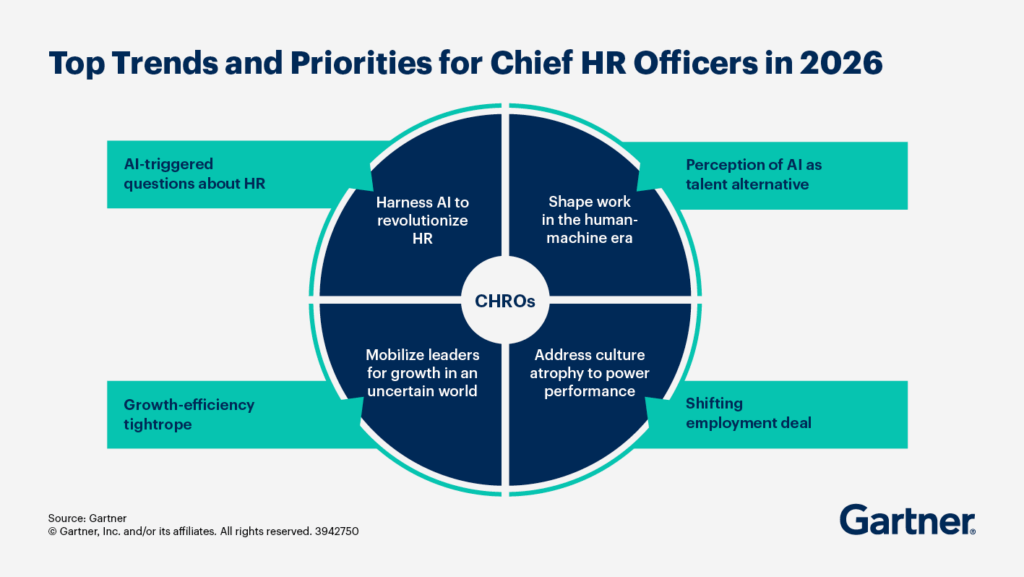
Gartner’s latest survey of over 400 CHROs confirms this shift. The HR trends of 2026 are not just passing fads; they represent a permanent change in the landscape. Four developments stand out: First, AI will become the backbone of HR. Second, work design will evolve beyond job descriptions. Third, leadership will shift from motivation to orientation. Finally, culture will become a measurable performance driver.
As AI moves into the core, HR will stop being an administrative function.
For years, organisations treated AI as an additional tool, such as a source of information, a chatbot or an analytics layer. However, this approach will no longer be viable in 2026. AI will have become the driving force behind the HR operating model.
Rather than providing summaries of the past, HR systems will show what is required for the future: which roles will change, where skill gaps will emerge, and where development should start in order to prevent bottlenecks. Routine tasks will become background noise.
The real work of HR will shift towards questions that only humans can answer:
- Which talents will be crucial for the next strategic cycle?
- How can we develop capabilities that are ahead of the market?
- In which areas must we intervene because technology alone cannot support the organisation?
This is one of the biggest HR trends in 2026 in terms of organisational consequences: HR will move from execution to navigation.
The way work is organised has changed; it is now skills-based, rather than job-based.
Job descriptions have become outdated. In many industries, they become outdated faster than they are created. Organisations that rely on rigid roles struggle to staff projects, identify internal talent, and adapt to market shifts.
The new logic is contribution-based.
- What needs to be achieved?
- Which competencies are required to achieve this?
- Who possesses these competencies, regardless of department or hierarchy?
Skill-based hiring opens the door to new talent pools. Internally, transparent skill inventories and project marketplaces reduce reliance on external recruitment. Learning becomes adaptive, with organisations building individual progression paths that update as soon as requirements shift, rather than relying on standard programmes.
Gartner’s “Now–Next” principle encapsulates this perfectly: deliver what is needed today while developing what will be critical in six months’ time. Of the HR trends in 2026, the shift to skills is the structural foundation on which everything else rests.
To dive deeper into how organisations build consistent and transparent skill structures, read our article “Skill Management System: A Guide to Successful Implementation.”
Leadership shifts from ‘driving change’ to ‘stabilising through change’.
Most leaders have been trained in communicating change. However, in 2026, communication alone will no longer be enough. Teams must navigate constant shifts in tools, operating models, customer expectations, and priorities. What they need is clarity. What matters right now? What does not? What will remain consistent, even amidst change?
Modern Development Conversations help teams maintain this clarity by creating a continuous rhythm of dialogue and shared priorities. For a deeper exploration of this topic, read our article “Development Conversations: 7 Proven Strategies.”
Leadership will become a stabilising force rather than a motivational one.
The most effective leaders in 2026 will be those who:
- Set boundaries in complexity
- Address strain instead of glossing over it
- Create psychological safety as a daily practice, not just a concept.
- Give teams enough certainty to remain effective, even when strategic paths change.
The role of HR is to redefine what ‘good leadership’ means and to develop leaders who can operate in uncertain situations.
Of all the HR trends in 2026, this shift in leadership philosophy is one of the least visible but most decisive.
Culture becomes a performance system, not a brand message.
Hybrid working, AI-supported workflows and reduced face-to-face time are putting the resilience of organisational cultures to the test. Culture can no longer simply be declared; it must be engineered.
In 2026, organisations ask different questions:
- How can a sense of belonging be fostered when teams rarely meet in person?
- How can values remain visible when processes are automated?
- And how can performance remain stable when roles and expectations keep changing?
The employee experience comprises touchpoints that either reinforce or erode the culture. Gartner describes the risk of ‘culture decay’, which is the gradual dilution of clarity, values and decision-making processes. This only becomes apparent when staff turnover increases, innovation slows or collaboration breaks down.
The most successful organisations treat culture as an operational discipline rather than just a statement on their website. Of all the HR trends in 2026, this is the one that will distinguish resilient companies from those that gradually lose cohesion.
The data behind the shift
Four priorities shaping HR trends in 2026 were agreed upon by 426 CHROs from 23 industries:
- AI as a strategic rather than operational HR capability.
- Work design based on skills rather than static roles;
- Leadership that provides orientation in uncertainty;
- Culture that is consciously reinforced through everyday behaviours.
These priorities mark a turning point: HR is evolving into the guardian of organisational adaptability.
Conclusion: What will HR really represent in 2026?
In 2026, HR will not be defined by new tools or frameworks. Rather, it is defined by a new self-image.
HR is becoming analytical without losing its human focus. It embraces technology without becoming cold. It becomes strategic without distancing itself from the people it serves.
The quality of decisions improves because HR recognises what others overlook. Leadership becomes the anchor that teams can rely on. Culture becomes the foundation on which performance is built.
The true story behind HR trends in 2026 is this: HR does not follow transformation — it shapes it.
