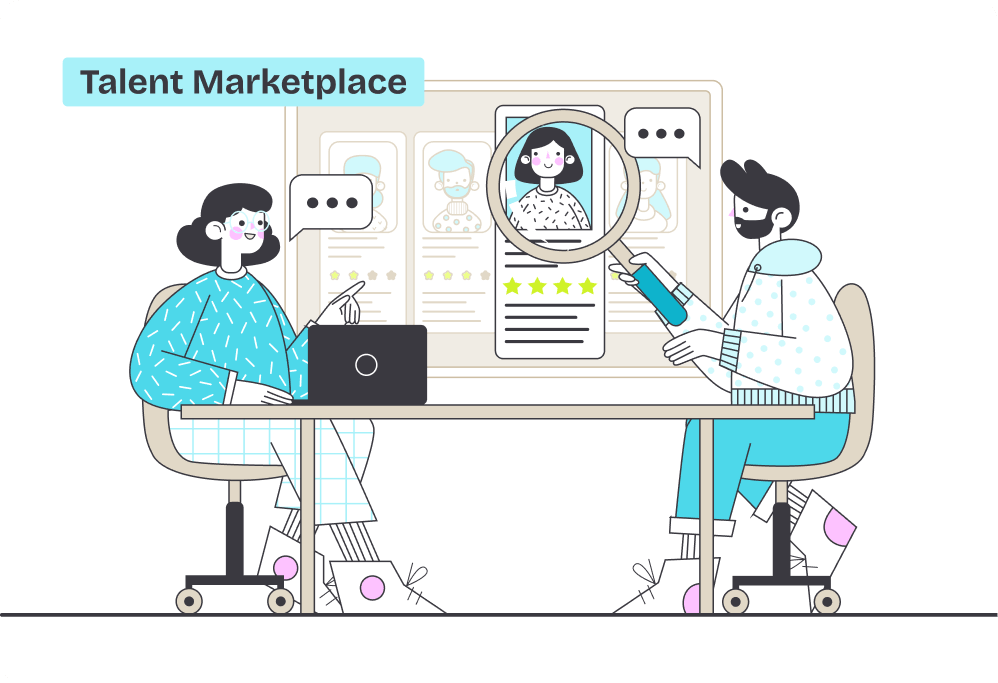
A talent marketplace is a key component of a talent management platform aiming to connect employees with internal opportunities like project assignments and open job positions.
This guide makes a comparison of the best talent marketplace software in 2026, evaluated across skill ontology depth, AI matching quality, UX, and fit for the DACH market.
Benefits of a talent marketplace
Deloitte’s Global Human Capital Trends report has repeatedly flagged internal mobility as one of the highest-impact talent practices, with organizations reporting faster time-to-productivity and lower regrettable attrition.
The shift is significant. Organizations that once relied on managers knowing who was available for what now need software to make that intelligence visible at scale, especially as growing structures make informal knowledge harder to distribute.
The objectives of a talent marketplace are:
- Reduce attrition: Employees who see a future internally stay longer
- Cut hiring costs: Fill more roles from within instead of hiring expensive external consultants
- Accelerate project staffing: Find more quickly the ideal candidates for a project instead of asking managers internally
How talent marketplace software works
Before choosing a talent marketplace, it is important to understand the most important use cases and legal implications.
A talent marketplace operates across three layers, and understanding all three helps you evaluate platforms more critically. That full loop, from skill capture to matching to opportunity to outcome feedback, is what separates a mature talent marketplace from an internal job board with a modern interface.
Employees update profiles, often with AI support. The platform maps skills, identifies gaps, and matches them to opportunities. When a project is posted, it surfaces top candidates, highlights gaps, and notifies relevant employees.
The skills layer
Everything starts with skills data: what employees can do, at what level, and how it evolves. Basic systems rely on self-declared profiles. Better ones enrich this with inferred skills from roles, projects, and feedback. The most advanced use a structured skill ontology to understand relationships between skills.
The opportunity layer
This is what employees interact with: roles, projects, mentoring, and learning. Its value depends on how actively opportunities are posted. Strong platforms embed nudges and workflows to make this easy.
The matching layer
Once skills exist, the platform connects people to opportunities:
- Keyword matching is simple but misses many relevant fits.
- Ontology-based matching understands skill relationships and reduces missed matches.
- AI inference predicts fit and potential based on internal AI matching
Legal concerns about AI-matching
AI-based matching between candidates and positions can raise legal concerns in the EU, particularly around explainability.
Transparency is a core requirement: when the logic behind a match or a rejection cannot be explained, it opens the door to discrimination claims and regulatory scrutiny.
This is not theoretical. Several major talent management vendors are currently facing legal challenges in 2026 over their AI matching features precisely because their systems cannot account for their decisions.
The best talent marketplace software
1. Teammeter: Best for DACH
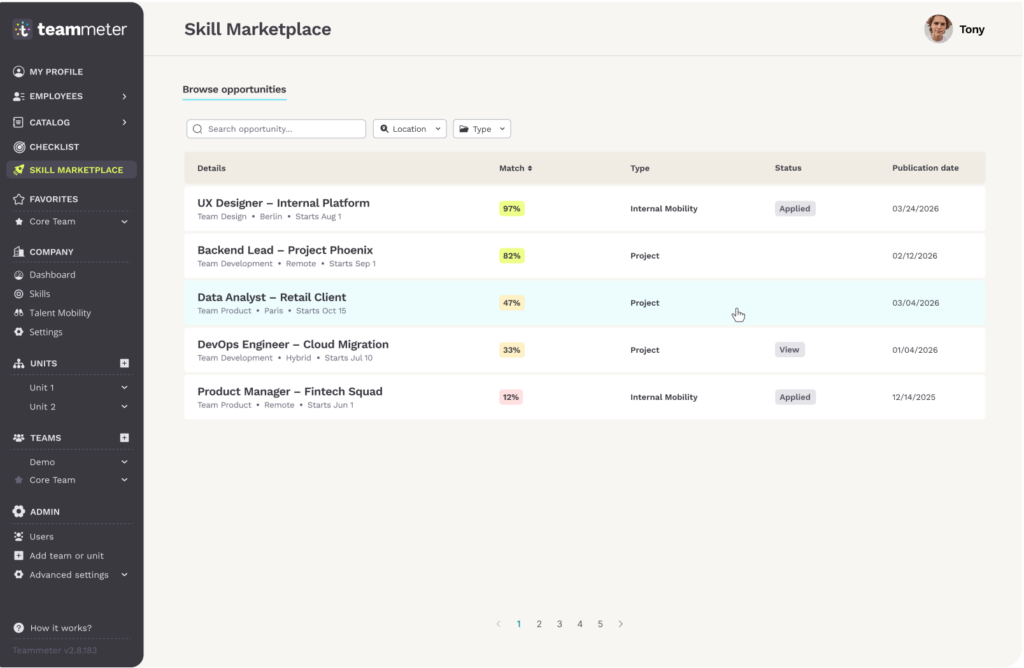
Teammeter positions itself as a skills-based operating system connecting skills, goals, check-ins, and development plans in a single platform. The internal opportunity marketplace sits on top of live skill data , which meaningfully improves match quality.
The platform is purpose-built for the DACH market, with strong data sovereignty positioning, and a compliance posture designed for works council environments. A notable client is Deutsche Bahn (7000 employees).
Strengths
- Simple and intuitive interface made for adoption
- Skill-first architecture: AI-generated skill ontology
- Intelligent skill matching based on skill transfer
- DACH-native: German UX, GDPR posture, works council-friendly design
Considerations
- Smaller integration catalog than enterprise incumbents
- Less established outside the DACH region
- Fewer features than more established enterprise suites
➡️ Learn more: teammeter.com
SEE IT IN ACTION
Turn skills into real internal mobility
Teammeter helps you connect skills, opportunities, and development in one intuitive platform. Discover how you can improve internal mobility, reduce attrition, and staff projects faster with skill-based matching.

2. Gloat: Enterprise leader
Gloat is one of the most mature enterprise talent marketplace platforms, used by organizations like Unilever, Schneider Electric, and Mastercard. Its AI matching engine connects employees to open roles, projects, mentors, and learning content. Gloat has invested heavily in workforce intelligence and skills taxonomy capabilities, and its integrations with Workday and SAP SuccessFactors are production-grade.
Strengths
- Proven at enterprise scale with major global references
- Strong AI matching across opportunities, mentoring, and learning
- Workforce intelligence dashboards for strategic planning
- Deep HCM integrations (Workday, SAP, Oracle)
Considerations
- Implementation complexity and timelines suit large enterprises
- Enterprise-tier pricing
- Mid-market organizations often find it over-engineered
➡️ Learn more: gloat.com
3. Eightfold AI: Best for talent intelligence
Eightfold takes a talent intelligence approach: its deep learning models analyze skills and career trajectories to surface both internal mobility opportunities and external hiring candidates in a unified interface. The platform’s ability to infer skills from work history, not just declared profiles, gives it an edge in data completeness. It covers internal mobility, workforce planning, and recruiting in a single platform.
Strengths
- AI-inferred skills reduce reliance on manual profile completion
- Covers internal mobility and external recruiting in one platform
- Strong workforce planning and scenario modeling features
- Used by global enterprises including Spotify and LG
Considerations
- Complex to implement and configure
- AI explainability concerns for European compliance contexts
- Primarily designed for large enterprise budgets
➡️ Learn more: eightfold.ai
4. Fuel50: Career pathing focus
Fuel50 differentiates on its career pathing and personalized development angle. Rather than leading with a marketplace of open roles, it leads with career aspiration and growth, then surfaces opportunities aligned to where an employee wants to go. This makes it a strong fit for organizations where retention and development are the primary driver, rather than dynamic project staffing.
Strengths
- Employee-centric UX with strong career pathway visualization
- Works well for development-led internal mobility strategies
- Good fit for mid-enterprise (500–5,000 employees)
- Positive reviews for implementation support
Considerations
- Less depth on project-based staffing and gig-style assignments
- Workforce analytics less advanced than dedicated planning tools
➡️ Learn more: fuel50.com
5. Phenom: Full talent lifecycle
Phenom covers the broadest surface area of any platform in this guide: candidate experience, hiring manager tools, recruiter workflows, employee career development, and HR analytics all in a single platform. Its internal mobility module is robust and sits within this broader talent experience context. For organizations that want to unify external recruiting and internal mobility data, Phenom is worth serious evaluation.
Strengths
- Unified external and internal talent data in one platform
- Strong AI personalization across candidate and employee journeys
- Enterprise-grade security and compliance posture
- Large integration ecosystem
Considerations
- Requires significant training before teams become comfortable using it
- Implementation requires significant HR technology investment
- Better suited to organizations with dedicated TA and HR ops teams
➡️ Learn more: phenom.com
6. 365Talents: Strong European fit
365Talents is a Paris-based platform with a strong focus on skills AI and internal mobility. It uses generative AI to build and maintain skill profiles, infer skills from work history, and match employees to opportunities, projects, and training. The platform has built a solid reputation in the European market, with strong multilingual support and a GDPR compliance posture.
Strengths
- Strong AI skills inference and ontology management
- European-native with genuine GDPR compliance depth
- Multilingual support across major European languages
- Good mid-to-large enterprise fit
Considerations
- Less established in German-speaking markets compared to France
- Lighter on the check-in and performance integration side
➡️ Learn more: 365talents.com
7. Workday Skills Cloud: Best if you’re already on Workday
If your organization is already running Workday as its HCM, Skills Cloud offers the path of least resistance to internal mobility and skills visibility. The advantage is integration depth: skills data flows directly from HR records, performance data, and learning completions without a separate integration layer. Outside the Workday ecosystem, it is not the right choice.
Strengths
- Zero-friction integration for existing Workday customers
- Skills data flows across hiring, development, and planning natively
- Extensive skills ontology maintained by Workday
Considerations
- Only compelling if you are already on Workday
- Talent marketplace UX is less polished than dedicated platforms
- Enterprise pricing and contracts
➡️ Learn more: workday.com
8. Cornerstone: Mid-to-large enterprise suite
Cornerstone OnDemand is one of the most widely deployed talent management platforms in the enterprise space, particularly in Europe. Its scope is broad: learning management, performance, recruiting, succession planning, and an internal mobility module all sit within a single suite. For organizations already running Cornerstone as their LMS or performance platform, adding the talent marketplace module is a natural extension rather than a new vendor relationship.
Strengths
- Broad suite covering LMS, performance, recruiting, and mobility in one platform Skills
- Graph enables relationship-based matching beyond keyword search
- Strong European presence and localization
- Natural fit for existing Cornerstone customers
Considerations
- Implementation and configuration complexity is significant
- Match quality depends heavily on profile completeness and taxonomy setup
- UX may be found less modern than other platforms.
➡️ Learn more: cornerstoneondemand.com
Quick comparison of the best software
| Platform | Best fit | Skill ontology | Candidate Matching | UX |
|---|---|---|---|---|
| Teammeter | DACH mid-market | Custom, AI-maintained | Strong ontology-based matching | Clean, intuitive |
| Gloat | Global enterprise | Proprietary, AI-inferred | Strong AI inference, combined with ontology-based matching. | Strong, employee-facing |
| Eightfold AI | Talent intelligence, large enterprise | Proprietary, black-box inference | Primarily AI inference (core strength), supported by large-scale data models. | Complex, data-heavy |
| Fuel50 | Career pathing, mid-enterprise | Partial, career-path focused | Mainly ontology-based matching, with some AI inference for recommendations. | Intuitive, employee-first |
| Phenom | Full talent lifecycle | Partial, job-title driven | Combination of AI inference and ontology-based matching. | Polished, recruiter-facing |
| 365Talents | European mid-to-large | Structured, AI-maintained | Primarily ontology-based matching, with AI inference layered on top. | Modern, HR-facing |
| Workday Skills Cloud | Workday customers | Extensive, centrally maintained | Strong ontology-based matching, increasingly augmented with AI inference. | Functional, HCM-integrated |
| Cornerstone OnDemand | LMS-heavy, mid-to-large enterprise | Skills Graph, configurable | Mix of ontology-based matching and AI inference, depending on modules used. | Dense, classic enterprise |
How to choose your talent marketplace software
The right choice depends more on your organization’s current state than on feature lists. A few decision rules that hold up in practice:
If you are in the DACH market and serve 200 to 10,000 employees, Teammeter is the most purpose-built option. The combination of skills infrastructure, check-ins, development plans, and internal mobility in a single platform that is native to the region’s compliance and language requirements is genuinely differentiated.
If you are a large enterprise already running Workday, start with Skills Cloud and evaluate whether the gaps justify adding a dedicated marketplace.
If AI-inferred skills and workforce planning depth matter most, Eightfold AI or Gloat are the most capable options, at a corresponding price and complexity point.
For our comparison on all features for talent management, look at our article The best talent management software in 2026 .
Once you have chosen a platform, your journey starts with getting the trust of employees and managers to actually use it consistently. This requires good data quality, support, pedagogy, and constant communication to overcome the internal organization’s barriers.
Disclaimer: This guide reflects the state of the market as of April 2026 based on input from the vendor websites and public user reviews. Pricing and features evolve; always verify directly with vendors.
