Lessons from a decade of skills management implementations across consulting and corporate environments
After ten years at the intersection of skills management, strategic workforce planning, and HR technology, certain patterns emerge. Some implementations achieve broad adoption and genuine business impact. Others produce expensive platforms with low engagement and data nobody trusts. The difference rarely comes down to the technology.
Here is what the successful ones have in common.
Answer the employee question first
Before configuring a skill taxonomy or selecting a platform, organizations need to address the question every employee will have: What’s in it for me?
At the organizational level, the business case is usually clear. Leaders want visibility into workforce capabilities, gap analysis, and a basis for strategic planning. That logic lands immediately with executives and HR teams.
But it does not automatically land with the employee filling out their profile on a Tuesday afternoon. They want to know who sees the data, what decisions it feeds, and whether participating actually benefits them personally.
The organizations that answer this well connect skills data to something employees already care about: learning and development. When a completed profile generates relevant course recommendations, or opens doors to internal mobility and project opportunities, the question shifts from “Why should I bother?” to “Why haven’t I done this yet?”
That link between skills and learning is consistently the most powerful adoption lever available. No internal communications campaign replicates it.
Executive sponsorship is not optional
High adoption rates do not happen through grassroots enthusiasm alone. They require visible, sustained support from leadership.
Skills management touches on questions that feel personal to employees: their expertise, their career, their value to the organization. Without a clear signal from the top that the initiative matters and that data will be used responsibly and to employees’ benefit, participation stays low and data quality suffers.
Effective sponsorship is not a one-time kick-off message. It means leaders visibly using the data, referencing it in decisions, and holding teams accountable for participation. When employees observe that skill data shapes real outcomes rather than disappearing into a system nobody consults, the cultural shift becomes possible.
Define the use cases before you define the taxonomy
One of the most common mistakes in skills management projects is treating the competency catalog as the starting point. Organizations spend months debating skill definitions, levels, and categorization before ever asking which business problems the data should actually solve.
The use cases should come first. Gap analysis at team level. Development planning at individual level. Workforce planning at organizational level. Internal mobility. Compliance tracking. Each use case shapes different requirements around what to measure, at what granularity, and who needs access to what.
When use cases are clear upfront, debates about taxonomy depth and skill granularity resolve themselves much more quickly. The question is no longer “how do we define this skill correctly?” but rather “what level of detail do we need to answer the specific questions we care about?”
The strongest use cases for getting initial buy-in from both leadership and employees tend to be team-level gap analysis and workforce strategy development. Team-level data sits at the right altitude: granular enough to reveal skill gaps within a specific function, yet abstract enough for managers to act on without drowning in individual-level variance. Individual-level skill data is often too granular to drive strategic conversations. Role-level aggregation is what makes company-wide workforce insights actionable and credible with senior stakeholders.
Role architecture is where projects get stuck
If there is one area where implementation projects consistently underestimate the difficulty, it is role definition. Almost every organization discovers, once the project starts, that their existing role structure is either too coarse to be useful or too fragmented to be manageable.
The most common pattern: tariff or job-grade clusters exist at the company level, but they are too broad to capture meaningful skill differentiation. Each department then ends up defining its own sub-roles, which introduces inconsistency and coordination overhead. Cross-cutting roles that span departments, such as Agile Coach or Data Analyst, require deliberate governance because no single department owns them.
A practical approach that has worked in complex organizations: establish a base profile per role rather than creating separate profiles for every seniority level. Junior and senior distinctions can be captured through performance management and individual development goals, while the role profile itself stays focused on the core skill requirements. This keeps the catalog manageable and avoids profile proliferation, which is one of the fastest ways to overwhelm both employees and administrators.
Around 150 roles is not unusual for a mid-to-large organization. At that scale, governance becomes a real operational challenge, not just a design question.
Keep profile length under control
Skill profile length is a practical problem that surfaces in almost every implementation and is easy to underestimate at the design stage.
Long profiles create several problems simultaneously. They discourage initial completion. They are harder to keep current. And they create noise in any automated matching or gap analysis that runs on top of the data.
Two structural decisions help contain this. First, separating “baseline skills all employees need” from “role-specific skills” keeps individual role profiles focused. Baseline skills can be maintained as a shared set that everyone holds, without cluttering every role profile. Second, resisting the temptation to enumerate every possible skill at the outset: starting with the skills that are genuinely relevant to the use cases defined upfront produces cleaner, more useful profiles than exhaustive catalogs.
Governance: get the process right — and keep it right
Related to role architecture is the question of who has the authority to create, edit, and approve role profiles. This is often treated as a secondary concern, resolved informally through workshops and email chains. In practice, it is one of the more consequential decisions of the entire project.
The answer varies by organization, but a pattern that works well in complex environments looks like this: department experts hold write access to the role profiles within their area, while cross-departmental roles are co-owned by a defined group of stakeholders. Changes go through a workshop or review cycle, with a hard deadline for input. No response by the deadline means no input considered. Profiles are reviewed annually, not continuously.
Without this kind of defined process, someone at HR ends up functioning as a full-time coordinator, managing email chains to track who has approved what change to which profile. The administrative burden quickly becomes unsustainable at scale.
Once the process is clear and stable, it is worth exploring whether the tooling can support it: change proposals, approval workflows, and defined ownership built directly into the platform. The process should be designed first, and the tool configured to match it, not the other way around.
A skills management implementation is not a project with an end date. It is an ongoing process that needs to be sustained. Roles change. New skills emerge. Business strategy shifts. The organization that builds a clean, well-governed skills catalog in year one and then leaves it untouched will find the data increasingly unreliable by year two or three. Annual role review cycles, clear ownership for catalog maintenance, and a defined process for introducing new skills or retiring obsolete ones are not optional features to be added later. They are part of what makes the implementation stick.
Technology is the last decision, not the first
The platforms available today vary substantially in how they handle skill taxonomies, team-level analytics, integration with learning systems, and configurability. These differences matter. But they matter much less than the decisions that precede them: which use cases to prioritize, how to structure roles, who governs the catalog, and how to connect skills data to outcomes employees actually care about.
The organizations that approach tools as the solution tend to struggle. The organizations that approach tools as infrastructure for a process they have already thought through tend to succeed. A well-designed process on a flexible platform consistently outperforms a poorly designed process on a sophisticated one.
When evaluating platforms, the questions worth asking are not primarily about features. They are about configurability at the team level, the ability to manage role governance without creating HR bottlenecks, the quality of the connection between skills data and development actions, and whether the tool surfaces insight at the right level of aggregation for the decisions that actually matter.
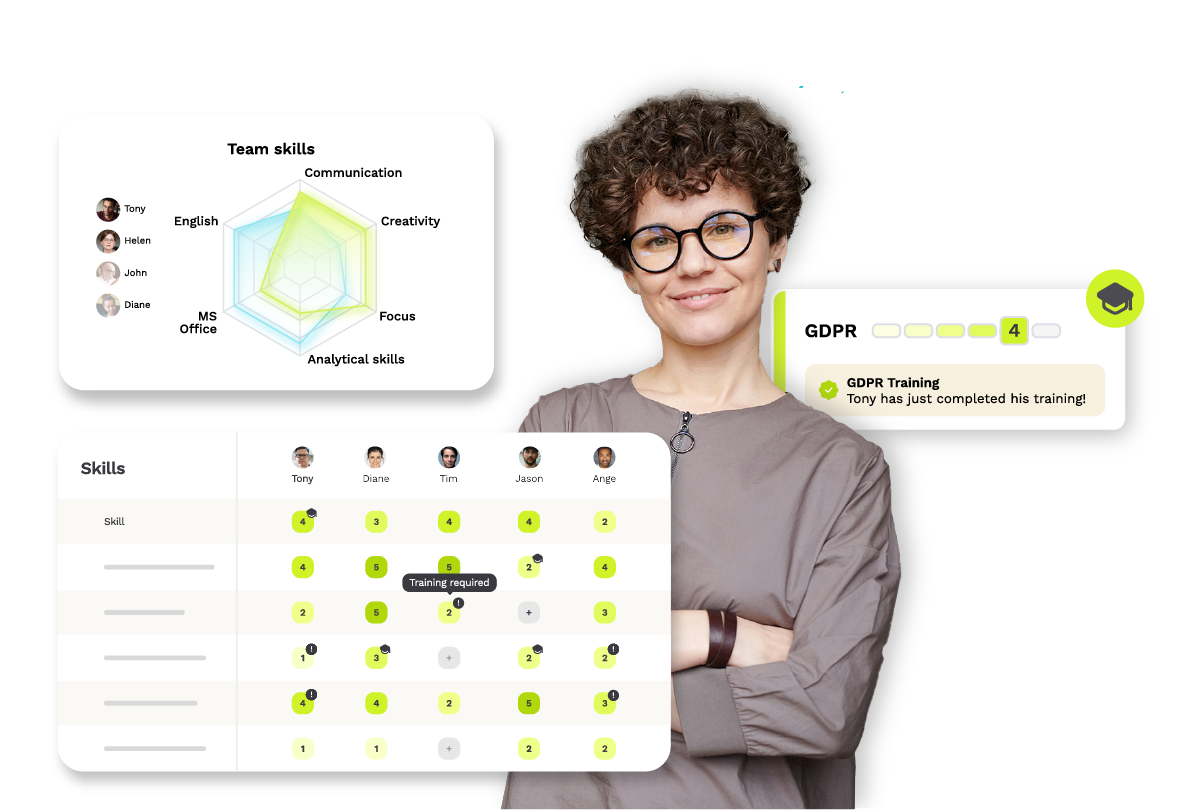
Teammeter is built around exactly these questions. It gives managers team-level skill visibility out of the box, keeps role governance in the hands of the people who understand the roles, and connects skill gaps directly to development actions — without requiring a dedicated HR operations team to keep it running. If the framework in this article describes how you want to approach skills management, the skill management in Teammeter is worth a look.
Skills management done well is not an HR initiative. It is an organizational capability. The implementations that achieve broad adoption and lasting impact are the ones that treat it that way from the start.
