Upskilling vs. Reskilling: What’s the Difference?
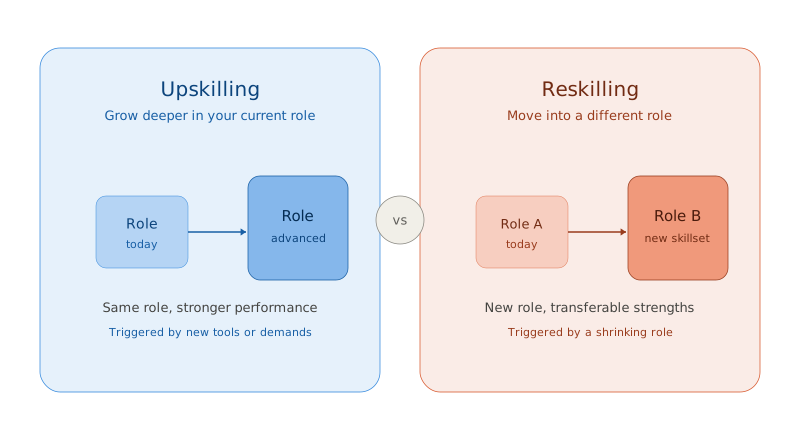
Let’s take a look at the differences between the two terms:
- Upskilling deepens existing competencies. An employee stays in their role or field but becomes more capable in it, for example, a marketing employee learning to use AI-powered analytics tools for campaign management.
- Reskilling builds an entirely new competency profile, usually for a different role or function. An accounting clerk retrained as a process-automation specialist because their previous work is being automated is being reskilled.
The distinction is more than semantics, because it triggers different investment logics:
| Upskilling | Reskilling | |
|---|---|---|
| Goal | Strengthen an existing role | Enable a new role |
| Time horizon | Continuous, incremental | Project-based, often with an end date |
| Trigger | New tools, rising requirements | Disappearing tasks, structural change |
| Risk of inaction | Declining productivity, falling behind | Redundancy, separation |
Both mechanisms, however, serve the same business goal: closing the gap between the competencies a company has and the ones it needs, using the existing workforce, rather than relying solely on external hiring or layoffs. The result is a more agile, more resilient organization with lower personnel costs and better employee retention.
The Benefits of Upskilling and Reskilling
The case for upskilling and reskilling is not just cultural goodwill, it is measurably cheaper and more reliable than the alternative, and it changes how people experience working for the organization.
For the organization
- Lower cost than external hiring. Upskilling and reskilling an existing employee runs at roughly half the cost of hiring externally for the median salary, and up to four times cheaper for above-median roles.[1] External hires also cost 18 to 20% more in total and underperform for their first two years on the job.[1]
- Faster time to full productivity. An internal candidate already understands the business context, the systems, and the people. It takes an external hire about two years to reach the same level of organizational insight.[2]
- Lower risk of an expensive miss. External hires are 61% more likely to be terminated than people who moved into a role internally.[2]
- Preserved institutional knowledge and a stronger succession bench. Growing capability from within reduces the single-point-of-failure risk that comes with critical skills sitting in one or two people who could leave at any time.
- A workforce that can absorb technological shifts. The same mechanism that closes today’s AI skills gap keeps working for whatever the next disruption is, without a full rebuild of headcount each time.
For employees
- Career security and relevance. Instead of watching a role become obsolete, employees have a structured path to stay ahead of it.
- Materially higher retention. 94% of employees say they would stay at a company longer if it invested in their learning and career development.[3]
- Real internal mobility. When strategic roles and skills are visible across the organization, moving into a new part of the organization becomes a normal career step, not a resignation followed by an external application.
- Recognition tied to actual growth. Development that is applied and reviewed in the regular appraisal cycle, not just completed, gives people credit for something real.
For teams and managers
- More flexible, cross-skilled teams that can cover for each other during absences, spikes in demand, or reorganizations.
- A visible succession bench, so a single departure does not stall a team’s roadmap.
- Benefits that are easy to see in team performance and retention, so the case for continuing to invest does not have to rely on anecdote.
Reading further
Knowing the definitions, the difference, and the payoff is only the first step.
See our practical playbook for the process that turns this into a system that actually holds up. We will take a look at the challenges of upskilling and reskilling and present tips for a successful implementation.
Sources
[1]: Lighthouse Research & Advisory: reskilling costs roughly half of external hiring at the median salary, and up to four times less for above-median roles; external hires cost 18 to 20% more and underperform for their first two years on the job, per Wharton School of Business research cited in the same piece.
[2]: Deloitte Review: Denise Moulton, Robin Erickson, and Bill Cleary, “Are you overlooking your greatest source of talent?” (July 30, 2018). “It typically takes two years for the performance reviews of an external hire to reach the same level as those of an internal hire.”
[3]: LinkedIn Learning Workplace Learning Report, as reported by CNBC: 94% of employees say they would stay at a company longer if it invested in helping them learn.
