Most companies have great talent on the bench and do not use fully this potential. Just because skills and opportunities stay hidden.
The gap between available skills and visible opportunity has a predictable outcome: external hiring goes up, and internal talent walks out. According to LinkedIn’s Workplace Learning Report, employees who feel their skills are not being fully utilized are among the most likely to start looking externally.
A talent marketplace fixes this. It makes internal skills visible, connects people to opportunities that match those skills, and turns internal mobility into an operational reality.
This guide explains what a talent marketplace is, how it works in practice, what you need to build one successfully, and how to measure whether it’s working.
What Is a Talent Marketplace?
A talent marketplace is a platform that connects employees to internal opportunities based on their skills, interests, and development goals. Those opportunities can be open roles, project assignments, mentoring relationships, stretch assignments, or training programs.
The core idea is simple: instead of always looking outside the organization when a need arises, you first look inside. And instead of relying on who a manager happens to know, you rely on structured skills data.
This is different from a job board or an intranet page listing open positions. A talent marketplace is dynamic. It learns what people can do, surfaces relevant opportunities to them, and makes matches visible to both employees and managers.

The Problem It Solves
Organizations face a structural information problem. Skills are distributed across teams, departments, and locations, but that information lives in people’s heads, not in any system. When a project needs a specific skill set, the default response is to hire externally, because internal search is too slow and too dependent on informal networks.
This creates several compounding problems:
- Hiring costs stay high even when the required skills already exist internally.
- Employees feel stuck because there is no visible path to new challenges or growth within the organization.
- Retention suffers as high-performers leave for opportunities they couldn’t find internally.
- Workforce planning is based on headcount, not skills, which makes it hard to close capability gaps strategically.
A talent marketplace addresses all four by creating a system of record for skills and a structured channel for internal opportunity.
The Skills Data Foundation
A talent marketplace is only as useful as the skills data it runs on. Before matching can happen, you need a reliable picture of what people can actually do.
Skill Profiles
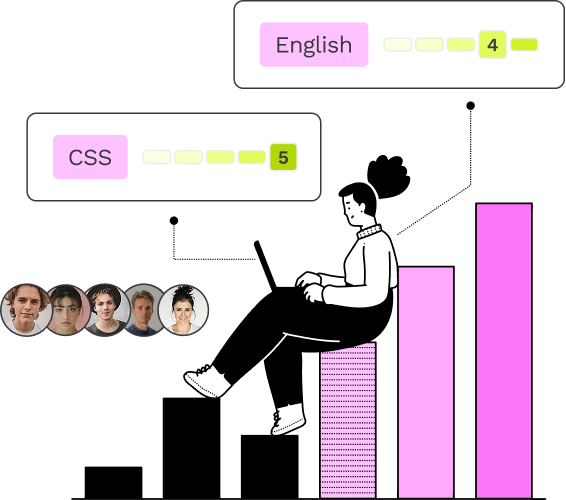
Each employee has a skill profile: a structured record of competencies, proficiency levels, and, ideally, self-assessment alongside manager or peer input. A good skill profile is not a resume. It is a living document that updates over time as people learn, take on new responsibilities, and complete development activities.
The key design choices here are:
- A shared skill taxonomy. Everyone in the organization should use the same language to describe skills. If one team calls it “stakeholder management” and another calls it “stakeholder communication,” matching breaks down. Building or adopting a consistent taxonomy is one of the most important early decisions.
- Proficiency levels that mean something. A four or five-level scale with clear behavioral descriptions works better than a binary “has this skill / doesn’t have this skill.” The difference between someone who can apply a skill with guidance and someone who can teach it to others matters a great deal for matching.
- Self-assessment with calibration. Employees should be able to rate their own skills, but those ratings need a feedback mechanism. Manager input, peer feedback, or skill assessments can calibrate self-reported data and make the profiles more reliable.
- Skills aspirations. Knowing what skills someone wants to develop is as important as knowing what they already have. This data drives matching to stretch opportunities and development-focused assignments, not just to roles that confirm what someone already knows.
Keeping Profiles Current
Static profiles are a common failure mode. A skill profile that was accurate two years ago tells you little about what someone can do today. The best systems make profile updates a natural part of regular workflows: after completing a training, after finishing a project, as part of a quarterly check-in, or triggered by a certification or badge.
How the Platform Works in Practice
The Employee Experience
From an employee’s perspective, a talent marketplace should feel like a personalized feed of relevant opportunities. When someone opens the platform, they see roles, projects, and assignments that match their current skills and their stated interests, not a generic list of everything open in the company.
They can express interest with a single action. They can see which of their skills are a strong match and which gaps they would need to close. They can track where their application stands. And they can explore what skills are in demand across the organization, which gives them signal about where to invest in development.
Transparency matters here. Employees are more likely to engage with the platform if they understand why certain opportunities are surfaced to them and if they can trust that expressing interest will not trigger any unintended consequences with their current manager.
The Manager and Project Owner Experience
On the demand side, a hiring manager or project owner describes what they need in terms of skills, not just job titles. They can see a ranked list of internal candidates who match those requirements, along with a view of each person’s skill profile.
This shifts the process from “who do I know who might be good for this?” to “who in the organization is actually the best match?” It surfaces people who would never have come up in an informal network and reduces the advantage of being well-connected over being well-skilled.
The HR and Workforce Planning View
HR teams and people leaders get an aggregate view: which skills are in surplus, which are scarce, where internal mobility is actually happening, and where it is not. This data feeds directly into workforce planning, learning and development prioritization, and sourcing strategy.
If a certain skill appears in demand across ten different projects but only a handful of people have it, that is a signal to invest in training, not to make ten separate external hires.
Opportunity Types
A talent marketplace is not only for permanent role changes. That is one of the most common misconceptions. The full range of opportunity types typically includes:
- Open roles and internal transfers. The most obvious use case. An employee applies for a permanent position in another team or department. This replaces or supplements the external hiring process.
- Project assignments. Short or medium-term assignments where someone contributes to a cross-functional initiative without leaving their current role. This is one of the highest-value use cases because it unlocks skills on a flexible basis without requiring a formal headcount move.
- Stretch assignments. Assignments designed specifically for development, where someone takes on work slightly beyond their current demonstrated ability. The goal is growth, not just productivity.
- Mentoring and coaching relationships. Matching employees who want to develop specific skills with people inside the organization who have those skills and are willing to share them.
- Job shadowing and learning experiences. Structured short-term exposure to a different function, role, or team to build understanding and inform career decisions.
Each of these types requires slightly different matching logic and different process governance, but the underlying skills data powers all of them.
Matching: How It Actually Works
Matching in a talent marketplace is not magic. It is the structured comparison of what someone has and wants against what an opportunity requires.
Supply and Demand
The supply side is the employee skill profile: current skills, proficiency levels, and development aspirations. The demand side is the opportunity description: required skills, nice-to-have skills, and experience requirements.
A match score reflects how well a person’s profile aligns with an opportunity’s requirements. But a good matching system also surfaces near-matches, people who meet most requirements and could close the remaining gap with targeted development. This is important for stretch opportunities and for roles where the organization is willing to invest in development.
Skills-Based vs. Role-Based Matching
Traditional recruiting matches on job titles and years of experience. Skills-based matching looks at actual competency. Someone who has been a “project coordinator” for three years may have strong stakeholder management, risk assessment, and planning skills that qualify her for a program management role, even if the title on her profile doesn’t suggest it.
This is the conceptual shift that makes a talent marketplace more powerful than a simple internal job board. The search starts from what someone can do, not what their last job was called.
Bias and Fairness
One significant advantage of skills-based matching is that it reduces the role of informal networks and manager visibility bias. Employees in high-visibility roles or close to senior leadership tend to get more opportunities in organizations without a marketplace. Skills-based matching creates a more level playing field.
That said, the underlying skills data is only as fair as the process used to collect it. If certain groups systematically underrate their skills in self-assessment, or if certain managers are less rigorous about providing skill feedback, the data can reproduce existing biases. This is why the governance of the skills data matters as much as the matching algorithm.
FREE SESSION
Let’s exchange ideas in a 30-minute sparring
Get a fresh perspective on your topic.
In this free 30-minute sparring session, we’ll explore ideas, challenge assumptions, and identify practical next steps.

Governance and Change Management
A talent marketplace does not run itself. The organizational design around the platform matters as much as the technology.
Manager Consent and Transparency
The most sensitive design question is whether employees need manager approval to express interest in an opportunity. There are legitimate arguments on both sides.
Open exploration (no manager approval required to browse or apply) increases participation and reduces the stigma of looking for new opportunities. It also gives employees more agency. The risk is that managers feel blindsided when someone on their team is actively pursuing a transfer.
Most organizations find a middle path: employees can browse and express interest freely, but formal applications or confirmed assignments require a conversation with the current manager. The platform facilitates this conversation rather than replacing it.
Opportunity Ownership
Someone needs to own each posted opportunity and be accountable for the matching and selection process. Without this, opportunities go unresponded to, which erodes trust in the platform quickly.
Clear SLAs (how long an opportunity stays open, when applicants receive updates) and assigned ownership are basic governance requirements.
HR as Enabler, Not Bottleneck
HR’s role in a marketplace model shifts from gatekeeper to enabler. Rather than approving every internal transfer, HR sets the rules of the game: the skills taxonomy, the proficiency level definitions, the governance policies, and the escalation paths when a manager holds someone back from a legitimate internal opportunity.
Change Management
The hardest part of launching a talent marketplace is not the technology. It is the culture change. Managers who have always relied on direct reports being “theirs” need to develop a different orientation, one where sharing talent across the organization is seen as contribution, not loss.
This requires visible sponsorship from senior leadership, clear communication about what the marketplace is and is not, and early wins that demonstrate value to both employees and managers.
Performance and Career Development
A talent marketplace is most powerful when it is connected to the rest of the people development system, not running in isolation.
Career Paths as Skill Journeys
When career paths are described in terms of skills, not just titles, employees can see exactly what they need to develop to move in a direction they want to go. A junior analyst who wants to become a product manager can see which skills they already have, which ones they need, and which internal opportunities would help them build those skills faster than waiting for a promotion.
This makes career development conversations more concrete and more actionable. Instead of “keep doing good work and something will open up,” managers can point to specific skill gaps and specific opportunities to close them.
Development Plans Linked to Opportunities
The connection between a development plan and a marketplace opportunity should be explicit. If someone is working to build a skill, the marketplace should surface opportunities that would let them practice or demonstrate that skill in a real context.
This closes the loop between learning intent and learning in practice, which is where most learning and development investment fails to convert into actual capability growth.
Check-Ins and Feedback Loops
Regular check-ins, where employees and managers review skill progress and update profiles, keep the marketplace data fresh and keep career development conversations on the agenda. Without this rhythm, profiles drift out of date and the marketplace loses accuracy.
Measuring Success
A talent marketplace generates its own measurement data. Here are the key metrics that matter:
Internal Fill Rate
What percentage of open roles and project assignments are filled by internal candidates? This is the headline metric. It tracks directly to hiring cost reduction and to the organization’s actual capacity to mobilize talent internally.
A baseline measurement before the marketplace launches is essential. Without it, you cannot demonstrate improvement.
Time to Fill (Internal vs. External)
How long does it take to fill a role internally compared to externally? Internal matches should be faster once the marketplace is operating well. If they are not, the process design needs attention.
Employee Participation Rate
What percentage of eligible employees have an active, current skill profile? This is a proxy for platform health. A marketplace where 20% of employees have profiles is not really a marketplace yet.
Opportunity Completion Rate
For project assignments and stretch opportunities: what percentage are completed successfully? This tracks whether matching quality is high enough to create productive experiences, not just placements.
Retention of Internal Movers
Are employees who have used the marketplace to move internally more likely to stay with the organization? This is one of the most meaningful long-term metrics. It connects the marketplace directly to retention outcomes.
Skill Gap Closure Rate
Are identified skill gaps actually being closed over time? This connects the talent marketplace to the workforce planning function and shows whether the organization is building the capabilities it says it needs.
How Teammeter Supports Internal Mobility
Teammeter is a skills-based platform built for upper mid-market and enterprises. It connects skills profiles, development goals, and internal opportunities in a single system, giving HR teams and people managers the data they need to move talent where it is needed most.
The platform supports the full workflow: structured skill profiles with self-assessment and manager input, an internal opportunity marketplace for roles and project assignments, development plan integration, and analytics for workforce planning.
If you want to see how this works in practice, book a live demo or compare Teammeter with other talent marketplace solutions.
Talent Marketplace vs. Related Concepts
Internal job board. A list of open positions employees can apply to. One-directional, not skills-based, and does not surface project assignments or development opportunities. A talent marketplace includes this capability but goes much further.
Talent management software. A broad category covering performance management, learning, succession planning, and more. A talent marketplace is a specific capability within talent management, focused on the supply-and-demand matching problem.
Skills management platform. A system for capturing and managing skills data across the organization. This is the foundation layer. A talent marketplace builds on top of skills management to enable matching and mobility.
Succession planning tool. Identifies candidates for specific future roles, usually senior leadership. Overlaps with a talent marketplace but is more targeted, longer-horizon, and typically managed by HR rather than opened to the broader employee population.
FAQ
No. It supplements it. For roles requiring skills the organization does not have, external hiring is still necessary. The goal is to increase the share of opportunities filled internally, not to eliminate external recruiting entirely.
This is a real risk and one of the most common reasons talent marketplaces underperform. The governance model needs to define clear rules about when a manager can hold someone back and for how long. Most organizations set a maximum tenure in current role before an employee has unrestricted right to apply internally. Senior leadership needs to actively reinforce the norm that releasing talent is a positive contribution.
Skill profile coverage builds over the first two to three months after launch. The first meaningful internal placements through the marketplace typically happen within three to six months. Measurable impact on hiring cost and retention usually becomes visible after the first full year.
The platform should be simple enough that formal training is minimal. But communication, not training, is the bigger investment. Employees need to understand what the marketplace is for, what they can expect, and how to use it to their advantage.
The concept applies at any scale, but the investment required to build and maintain a skills taxonomy and keep profiles current makes it most practical for organizations with 200 or more employees. Below that threshold, the informal networks that a marketplace replaces tend to function well enough.
Skill profiles contain personal data and need to be treated accordingly. Employees should have visibility into what is stored about them and the ability to correct it. Data use should be limited to the stated purpose of opportunity matching, and access controls should prevent skill data from being used in performance management or compensation decisions without employee awareness.
Skills-based hiring applies the same logic to external recruiting: evaluate candidates on demonstrated skills rather than credentials or job titles. A talent marketplace that generates clean internal skills data also sets a consistent standard for how external candidates are assessed, creating coherence between internal and external talent processes.
