
✦ In short
AI Workforce Readiness describes how prepared an organization’s people, roles and structures are to work with AI. 56% of the HR departments surveyed in Germany have no model of their own yet for AI competence and responsibility (Kienbaum and BPM, 2026).
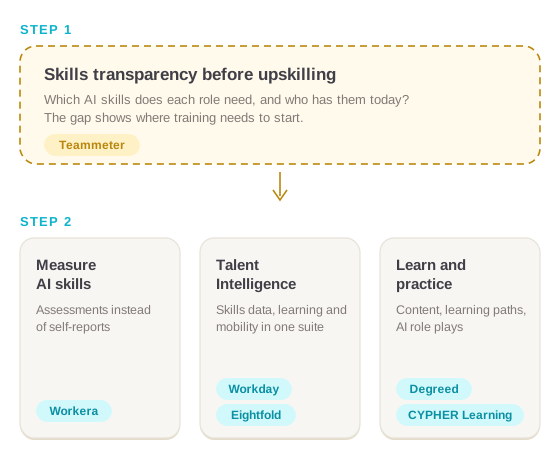
- Skills inventory: Teammeter
- Measure AI skills: Workera
- Enterprise suite: Workday, Eightfold
- Learn and practice: Degreed, CYPHER Learning
Our learning: Start with the skills inventory. Only the gap per role shows you which courses you need.
“Suddenly everyone had to take the training.” That is how an HR consultant described to us in July how the AI Act had landed in her organization.
At Zukunft Personal in Cologne in September, the questions that come after the training were asked openly, in workshops and in talks:
Which skills do I still need to learn at all?
How do I recognize critical future skills and translate them into my own role profile?
This comparison shows you six solutions and where each of them comes in.
What AI Workforce Readiness means
AI Workforce Readiness describes how prepared an organization’s people, roles and structures are to work with AI. It is less about the technology and more about whether the workforce can actually use it. It usually covers five areas:
- Skills: AI literacy for everyone, meaning what AI can and cannot do, prompting and judging outputs critically. Plus deeper technical skills for specific roles, such as data, machine learning or integration. And the human skills that matter more once routine tasks are automated: judgment, problem framing, communication.
- Roles and tasks: You know which tasks in which roles will be automated, augmented or left unchanged. And which new roles appear, such as AI product owner or AI governance lead.
- Adoption and culture: People trust the tools, experiment with them and change how they work. The opposite is AI that is licensed but barely used.
- Governance and ethics: Clear rules on acceptable use, data protection and accountability. In the EU, the AI literacy obligation under Art. 4 of the AI Act has applied since February 2025. That makes it a compliance topic and not only a best practice.
- Learning infrastructure: People can be upskilled and reskilled quickly and continuously, not only in a one-off training.
AI Workforce Readiness is usually measured like this: organizations map current skills against the skills that AI-affected roles will need. They look at the gap by team, role or individual. From that they build targeted learning paths, internal mobility moves or hiring plans.
56%
of the HR departments surveyed in Germany have no model of their own for AI competence and responsibility.
Source: Kienbaum and the German Association of HR Managers (BPM), “Künstliche Intelligenz in HR 2026”, 151 responses analyzed
In the Global Human Capital Trends 2026, Deloitte describes leadership as increasingly including the leadership of machines: setting the scope of AI agents, judging model outputs and knowing when to step in. According to Deloitte, these are new skills for most leaders.
Five criteria for every vendor demo
Take these five points into every vendor demo:
- Skills model: You create AI skills yourself, describe them and assign them to roles.
- Assessment: The level is assessed on a described scale or measured by a test. Course completions alone do not show it.
- Visibility: The software controls whether the whole company, the team or only the manager sees an assessment.
- Gap: You see the gap by team, role or individual, meaning how many people need a skill at which level and how many have it today.
- Next step: The gap turns into a learning path, an internal move or a hiring plan.
For German companies, two more points belong on the list: involving the works council and where the data is processed. As soon as software stores the skills data of individual people, the works council has a right of co-determination under Section 87(1) No. 6 of the Works Constitution Act.
Which solution fits when
| If you … | Start with … |
| want to see first which AI skills your workforce has and which are missing, for companies from around 200 employees | Teammeter |
| already use Workday as your HR system | Workday Skills Cloud |
| mainly want to build AI skills through hiring | Eightfold |
| want to measure AI skills with assessments | Workera |
| want to bring many learning sources together in one place | Degreed |
| want people to practice conversations with AI | CYPHER Learning |
Category 1: Skills transparency before upskilling
Teammeter 🇩🇪
Teammeter is a platform for skill management. It answers the first question of readiness: which skills does your organization have, and which are missing? Teammeter connects learning content through a) an integrated mini LMS that maps training content but focuses on evidence, training effectiveness and the training matrix, or b) an integration with an LMS provider. It shows you where training needs to start and links skills to training resources and development plans.
What this means for AI skills:
- Create your own AI skills: You add new skills such as prompt design or judging model outputs to the skill catalog. The AI suggests a description and the matching category, you decide.
- Roles with requirements: When you create a role, the AI suggests matching skills, from your catalog and new ones. For each skill you define how many people need it at which level.
- Skill matrix per team: The matrix shows where coverage is sufficient and where it is not. Custom scales are possible, for example for languages from A1 to C2.
- Skill graph: The AI links skills to each other, for example as a prerequisite, a specialization or part of another skill. That way you see which existing skills are a prerequisite for a new one.
- Visibility by role: Anyone who may view a matrix without appearing in it gets a dedicated role for that.
- Health checks: They measure what skills data does not show: how confident teams feel using AI, whether they trust the tools and whether AI actually changes how they work. Repeat them and you see how adoption is progressing.
- Compliance tracking: You document AI literacy per employee as evidence for the obligation under Art. 4 of the AI Act.
The AI helps with setup, with descriptions, categories and suggestions.
On where data is processed: Teammeter is ISO 27001 certified, and the data is stored on servers in Frankfurt.
Category 2: Talent intelligence platforms
Workday Skills Cloud
According to Workday, the Skills Cloud uses AI to recognize connections between the skills in an organization. It feeds job recommendations, personalized learning content and a talent marketplace. Workday states that 30 percent of Fortune 500 companies use the Skills Cloud. It is mainly of interest to companies that already use Workday as their HR system.
Eightfold
Eightfold describes itself as an “agentic talent intelligence company”. By its own account, the platform draws on 1.6 billion career paths and 1.6 million skills. The focus is on recruiting, with an AI interviewer and a candidate agent, plus talent and resource management. Deutsche Telekom is among the customers it names. Eightfold fits when AI skills are mainly meant to come into the organization through hiring.
Category 3: Measuring AI skills
Workera
Workera measures AI skills with scenario-based assessments instead of self-reports. It measures six dimensions, including AI fundamentals, prompt and agent design, risk and ethics, and human skills. According to Workera, the Ambient module also reads signals from work applications. By its own account, 10 percent of Fortune 500 companies use Workera.
Category 4: Learning platforms
Degreed
Degreed combines a learning platform with skills data. The modules are called Degreed Maestro for AI-supported learning, Degreed Skills+ for skills data and Degreed.AI for connecting to the tools your teams work with. The reference customers on the website are large corporations such as Ford, HSBC and Verizon.
CYPHER Learning
CYPHER Learning is a learning management system with AI features. The AI Practice module builds conversation scenarios and role plays. At Zukunft Personal in Cologne we trained in such a simulation ourselves, with an AI as the counterpart, and repeated the run as often as we liked. A role play otherwise needs a second person, a trainer and a slot in the calendar. These three requirements disappear here.
FREE SESSION
Let’s exchange ideas in a 30-minute sparring
Get a fresh perspective on your topic.
In this free 30-minute sparring session, we’ll explore ideas, challenge assumptions, and identify practical next steps.
How to combine the categories
The categories are not mutually exclusive. A suite often includes learning content, and a skills model triggers training.
Our learning:
Start with the skills inventory. Only the gap per role shows you which courses you need.
For mid-sized companies this means: first a skills model with AI skills and a matrix per team, then targeted learning content. Large corporations with an HR system such as Workday should first check what is already covered there.
Frequently asked questions
What is AI Workforce Readiness?
How prepared an organization’s people, roles and structures are to work with AI, from skills to adoption and governance to learning infrastructure. It is measured by the gap between the skills that AI-affected roles need and where people stand today.
Do I need a learning platform for this?
Not to get started. A learning platform provides content. Only a skills inventory shows you which content you need.
Who decides which AI skills a role needs?
HR together with the managers of the role in question. In Teammeter, the AI suggests skills for a role, and the decision stays with you.
Where does your workforce stand today?
If you want to go through the five criteria above for your organization, let’s look at them together. Book a demo, and we will show you how AI skills sit next to professional skills in one matrix and who sees what.
