Long before anyone used the word “competency,” European trade guilds had already built a competency model of one. A guild recognized three ranks: apprentice, journeyman, and master. An apprentice was bound to a master’s household for a fixed term, often seven years, receiving training and lodging instead of wages. A journeyman had finished that training and could sell his labor by the day, but could not employ anyone or run a shop of his own. Advancement to the top rank was not granted by time served or by examination. The candidate had to produce a masterpiece, an actual finished object, and submit it to the assembled masters of the guild for judgment. If they rejected it, he stayed a journeyman, in some cases for the rest of his life.
The vocabulary outlived the guilds themselves. Germany abolished them but kept the three ranks, and the Meisterbrief remains a state-recognized qualification under the Handwerksordnung, still legally required to run a business in safety-critical trades such as electrical work and chimney sweeping. The underlying distinction survived too, and it is the one every competency model since has been built on: a certificate records what somebody studied; a competency records what people can do.
Understanding competency models

Characteristics of a competency model
A competency model is not simply a longer list of skills. It differs from a skill inventory in three specific ways.
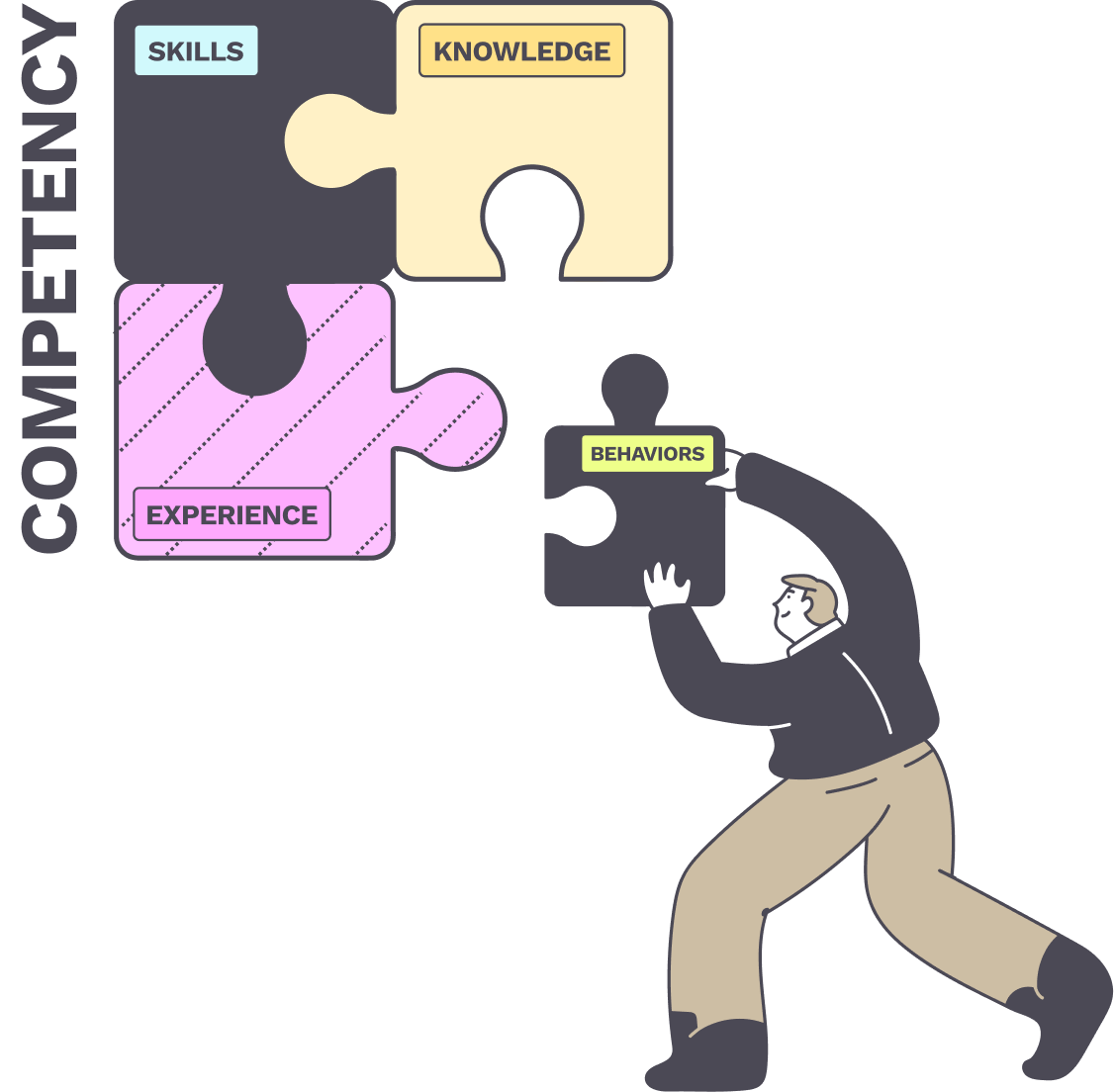
Competency vs. skill. A competency covers the skill (the ability itself) as well as the experience needed to perform a role. I’ve written an article on the difference between the two terms: What is the difference between abilities and skills?
The competency iceberg. In their 1993 book Competence at Work, Lyle and Signe Spencer described competencies as an iceberg. Skills and knowledge sit above the waterline: visible, and relatively easy to train. Self-concept, traits, and motives sit below it: hidden, slower to change, and usually the real reason two equally skilled people perform differently under pressure. A competency model that only measures the visible half is measuring the easy half.
Behavioral indicators, not job tasks. A job description lists duties someone is assigned. A competency model lists behaviors someone actually demonstrates, tied to outcomes. “Manages a budget” is a duty. “Flags cost overruns without being asked” is a behavioral indicator. Only one of those tells you whether the person is any good at it.
Progression. Most mature models describe the progression of competency. This progression can be based on mastered complexity, autonomy, or influence, as described in our article about how to choose the right skill scale.
The challenges of competency models
Choosing the proper granularity
Granularity represents how specific a skill should be. The more granular a model is, the more skills are in the model, which describes capability more precisely but makes the model harder to keep alive. A catalog with 2,000 entries is not more accurate than one with 200, it is just more work: every entry needs an owner, a definition and a reassessment cycle, and the more entries there are, the more likely it becomes that two people describe the same capability under two different labels. Too coarse a model has the opposite problem. “Communication” or “IT” tells you nothing you can staff a project with.
The useful boundary sits where the organization’s own language already sits. For decades, CVs have compactly described what a person can do, and their counterpart, the job posting, describes what a role needs. Both have settled on roughly the same level of detail, because that is the level at which people actually talk about capability.
So the first test for the right granularity is simple: could this skill appear, in exactly this form, in a CV or in one of your own internal job postings?
A second test catches the more common mistake, which is filing tasks as skills: can you say “this person is an expert in …” and have it sound right?
A model that goes stale the moment it’s finished
Competency models are often built as a one-time project: a workshop, a dictionary, a PDF. But the same Deloitte survey found that a shift in the skills required to do the work itself, not a new tool or a reorg, was the most frequently cited driver of organizational change, named by 39% of workers. A competency model finished in January is already behind by the time it ships.
One dictionary does not fit every role
The temptation, once a competency model exists, is to apply the same handful of competencies to every role in the company. But the behaviors that make a great support engineer look nothing like the behaviors that make a great enterprise sales rep. A model general enough to cover everyone is usually too vague to predict anything.
Competency models in personal development
Finding competency gaps
Once a competency model exists with proficiency levels attached, personal development stops being abstract. An individual development plan is, in practice, just the distance between where an assessment says someone is today and where the model says they need to be for the role they want next. The model doesn’t just describe the organization; it hands each person a map of exactly what to work on, instead of a vague instruction to “grow.”
Increasing competency
Upskilling is developing deeper proficiency in the competencies someone already uses in their current role, as opposed to reskilling, which builds the competencies for a different one.
In 1996, Morgan McCall, Michael Lombardo, and Robert Eichinger surveyed nearly 200 executives about how they’d actually developed the competencies that mattered most in their careers, and packaged the results into what became known as the 70-20-10 model:
- 70% of real development comes from challenging assignments on the job
- 20% from feedback and relationships with other people
- 10% from formal coursework
Personal development happens through several upskilling methods, and the ones that run through the work itself, stretch assignments, coaching and feedback, matter far more than formal training.
Our upskilling software helps personal developers integrate learning in the flow of work.
Competence as a need, not just a score
Psychologists Edward Deci and Richard Ryan named competence one of three basic psychological needs, alongside autonomy and relatedness, that drive intrinsic motivation, in the self-determination theory they built from the mid-1980s onward. People don’t just tolerate getting better at something; they’re wired to want to. A competency model’s real value for personal development isn’t the score it produces. It’s that it turns “get better” from a vague aspiration into a specific, visible target someone can actually aim at and feel themselves closing in on, provided the feedback behind it is specific enough to act on.
That last condition is also why a competency model only helps personal development when the person can see their own data directly, not just their manager. A skill profile an employee owns, like the one in Teammeter, turns the model from an HR document into a tool people actually use on their own behalf.
Conclusion
A competency model, done well, replaces a static list of duties with a living, evidence-based picture of what people can actually do, and does for hiring, promotion, and staffing what McClelland’s original study did for the State Department: it swaps a proxy for the real thing. But that only holds if the underlying data stays current, verified, and specific to the role, which means a competency model is not a project with an end date. It is infrastructure that needs the same ongoing investment as any system the organization actually depends on. Tools like Teammeter’s skill matrix exist precisely to keep that infrastructure alive instead of letting it calcify into another binder nobody opens.
References:
- McClelland, D.C. (1973). “Testing for Competence Rather Than for Intelligence.” American Psychologist, 28(1), 1–14.
- Spencer, L.M. & Spencer, S.M. (1993). Competence at Work: Models for Superior Performance. Wiley.
- Dreyfus, S.E. & Dreyfus, H.L. (1980). A Five-Stage Model of the Mental Activities Involved in Directed Skill Acquisition. University of California, Berkeley. https://en.wikipedia.org/wiki/Dreyfus_model_of_skill_acquisition
- Benner, P. (1984). From Novice to Expert: Excellence and Power in Clinical Nursing Practice. Addison-Wesley.
- Deloitte (2026). Global Human Capital Trends: “From tensions to tipping points: Choosing the human advantage.”
