
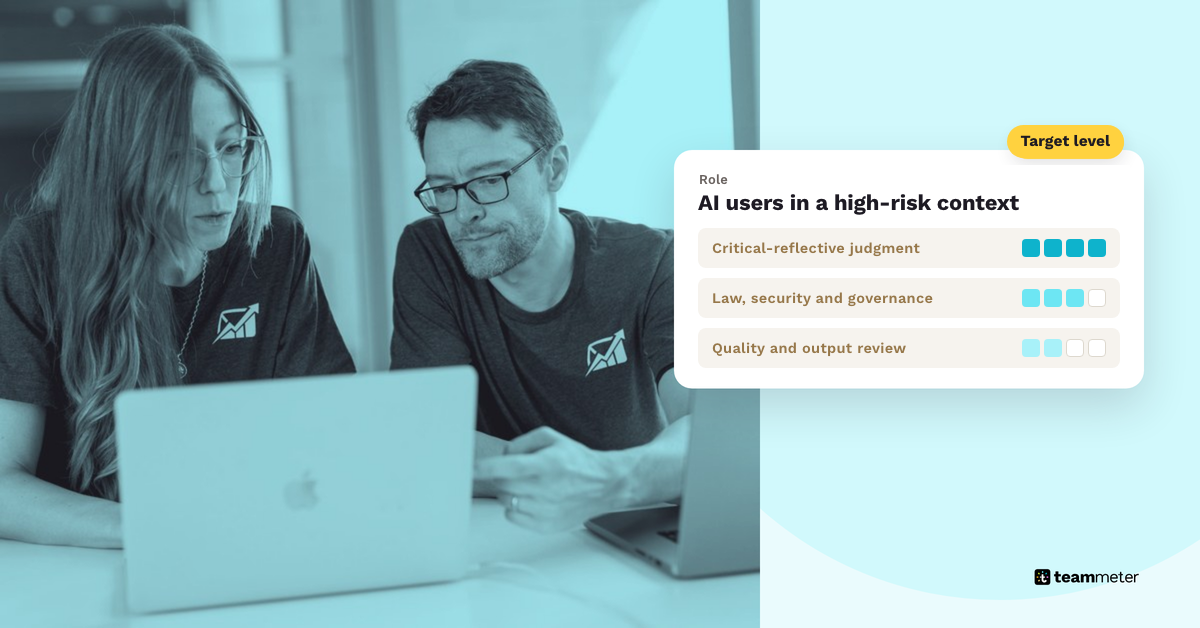
Drafting a job ad with a chat assistant calls for different AI skills than pre-screening applications with an AI system. The AI Act lists systems for the second task among the high-risk AI systems in Annex III. In its questions and answers on AI literacy, the European Commission puts it this way:
“There is no one size fit all when it comes to AI literacy.”
This article gives you an AI skills matrix for five roles, with the target level for each skill cluster. After that, it covers how to assess where people stand today and how to turn the gap into a training plan. You can download the matrix as an Excel template and adapt it to your company.
In short
- An AI skills matrix shows, for each role, which AI skills it needs and at what level.
- The roles follow how a person works with AI. One person can hold several of them.
- Our model describes five roles. For each one, it sets the target level in twelve skill clusters on a scale from 1 to 4.
- The gap between target level and current level tells you who needs training and where colleagues can pass on what they know.
What is an AI skills matrix?
An AI skills matrix is a table with the target level that each role in the company should reach in each AI skill. The skills sit in the rows, the roles in the columns. Put your employees’ assessments next to it and you see the gap for every person and every team.
With AI skills, what a person needs depends on how AI is used in a given task, and that can change within the same job. Sonali Suriya, whose model the matrix comes from, gives the example of one job with two different requirements: drafting texts, or helping decide about people. That is why the roles in this matrix are cut by context of use. You can see what this looks like in Teammeter on the skill matrix software page. What AI skills are in the first place, and how to build them in seven steps, is covered in the article on AI skills.
The five roles in working with AI
Our model distinguishes five roles. Their names come from the model, not from the AI Act. They follow how a person works with AI, and the person’s place in the hierarchy plays no part. One person can hold several roles.
AI users in a standard context
People in this role use AI as a tool in their own work, to draft, research, summarize or translate. Their output goes through a human check anyway and has no direct effect on other people’s rights or chances. Among the hard skills, tool use sits highest here, at level 3: using the approved tools independently, including in new work situations. On top of that comes knowing which data may be entered and which may not.
AI users in a high-risk context
Here the system affects people, for example in selection, assessment or performance reviews. High-risk AI systems are the systems that the AI Act classifies as such in Article 6 and Annex III. In the model, this person is the human oversight that the deployer, under Article 26(2) of the AI Act, assigns to natural persons “who have the necessary competence, training and authority”. Sonali describes this person as the last point where a flawed or biased result can be caught before it has consequences. In critical-reflective judgment, this role needs the highest level: assessing outputs independently and challenging the system with good reason. Under Article 14(4)(b) of the AI Act, this oversight should be enabled to remain aware of automation bias, meaning the possible tendency to rely automatically or excessively on the output of a high-risk AI system.
AI multipliers
Multipliers do the same kind of work as users and also carry skills into their team. They are the easy-to-reach contact people ask before anyone calls the legal department. They need level 4 in tool use and in communication: opening up new tools and explaining them to others without lecturing. For law, level 2 is enough: they know the obligations of their own area and when to bring in the people responsible.
AI process designers
Process designers decide how AI is used in their own business process, at which step a system does the work and who checks the result. They know the process better than anyone else, so they can judge whether a system is fit for the purpose. They need the highest level in domain knowledge and in decision-making and problem-solving, because they rethink workflows instead of just automating what already exists.
AI owners
This role makes the decisions with an impact beyond the team: procurement, risk classification, rules for use and, when in doubt, banning a use case. It includes managers as well as legal, data protection and compliance functions. Owners need level 4 in five of the twelve clusters, including law, security and governance as well as ethical responsibility. For tool use, level 2 is enough: they should be able to work with the tools themselves to see what they can and cannot do.
The scale: four levels
Each level comes with a description of what a person does in that skill. Sonali brought the four levels together from three expert sources that use different terms but follow the same order. The last column shows how her levels match the terms in those sources.
| Skill level | Level name | Meaning | Equivalent in the sources |
|---|---|---|---|
| 1 | Know | knows what it is about, can join the conversation and sees why it matters | know about, Awareness, Beginner |
| 2 | Apply | acts independently in familiar conditions | use it, Working, Advanced Beginner |
| 3 | Transfer | acts confidently in new, more complex situations | adapt it, Practitioner, Competent |
| 4 | Shape and pass on | develops the skill further, advises and trains others | live it, Expert, Expert |
If a role does not need a skill at all, its cell in the matrix stays empty. For soft AI skills, the level alone is not enough: there you write behavioral anchors, descriptions of the behavior you can observe at a given level. How many levels a scale should have in general is covered in the article Choosing the right skill scale.
The AI skills matrix for five roles
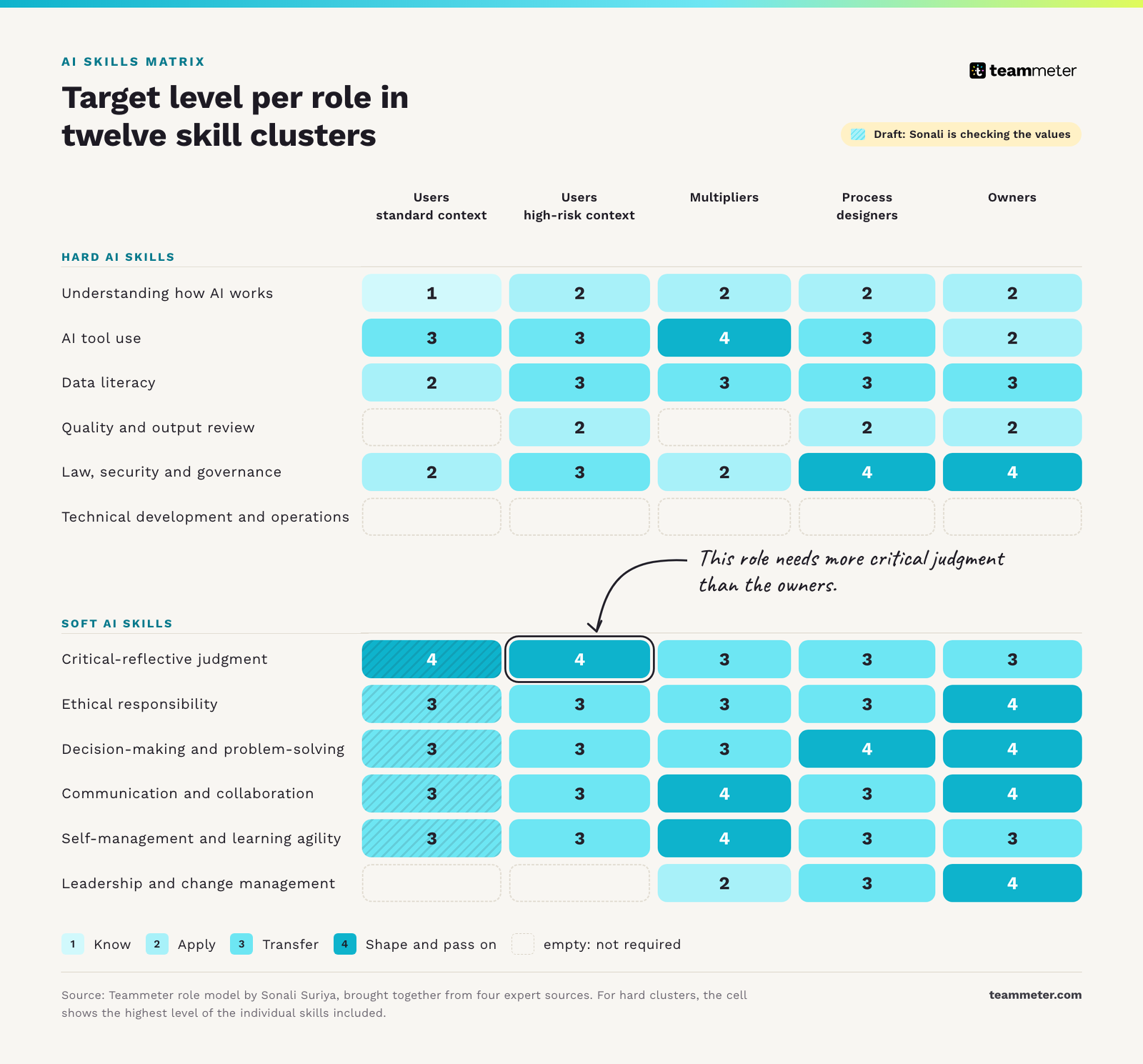
For the hard clusters, we entered the highest level of the individual skills listed in Sonali’s role profiles. One example: for process designers, level 4 in law, security and governance comes from the domain knowledge that sits in this cluster.
| Skill cluster | Users, standard | Users, high-risk | Multipliers | Process designers | Owners |
|---|---|---|---|---|---|
| Hard AI skills | |||||
| Understanding how AI works | 1 | 2 | 2 | 2 | 2 |
| AI tool use | 3 | 3 | 4 | 3 | 2 |
| Data literacy | 2 | 3 | 3 | 3 | 3 |
| Quality and output review | 2 | 2 | 2 | ||
| Law, security and governance | 2 | 3 | 2 | 4 | 4 |
| Technical development and operations | |||||
| Soft AI skills | |||||
| Critical-reflective judgment | 4 | 4 | 3 | 3 | 3 |
| Ethical responsibility | 3 | 3 | 3 | 3 | 4 |
| Decision-making and problem-solving | 3 | 3 | 3 | 4 | 4 |
| Communication and collaboration | 3 | 3 | 4 | 3 | 4 |
| Self-management and learning agility | 3 | 3 | 4 | 3 | 3 |
| Leadership and change management | 2 | 3 | 4 |
Four things stand out when you read it:
- All five roles: none of them needs to code. Whether you add a technical role of your own is something you decide when you align the model with your company.
- Users in a high-risk context: they need level 4 in critical-reflective judgment, which puts them above the owners.
- Multipliers: their profile peaks in tool use, communication and self-management, where level 4 means making new things usable for others.
- Owners: they get by with level 2 in tool use, but need level 4 in leadership and change management.
The matrix is available as an Excel template with the five role profiles, a description of each level and a sheet for the assessment.
The AI skills matrix as an Excel template
Five role profiles, a description of each level and a sheet for the assessment.
After registering, you will receive the link to the template. In addition, we will regularly send you information about our services and products. You can unsubscribe from these emails at any time. By submitting your data, you accept our Data Protection Policy.
One job, two roles: the recruiting example
Within HR, AI has gone furthest in recruiting and onboarding. In the study “Künstliche Intelligenz in HR 2026” by Kienbaum and BPM, 35 percent of HR departments use generative AI in production there, up from 18 percent in 2024. Two roles can come together in a single recruiting job.
Drafting the text of a job ad with a chat assistant is AI use in a standard context, as long as someone checks the text before the ad goes live. If the same person works with a system that analyzes or filters applications, they are an AI user in a high-risk context. The AI Act lists such systems in Annex III, point 4(a):
“AI systems intended to be used for the recruitment or selection of natural persons, in particular to place targeted job advertisements, to analyse and filter job applications, and to evaluate candidates”
Note the word “place”. Targeting who sees a job ad is on the list, writing its text is not. Under Article 6(2), systems listed in Annex III are considered high-risk. Article 6(3) makes an exception when a system does not pose a significant risk, for example because it only performs “a narrow procedural task”. The provider makes this assessment and must document it.
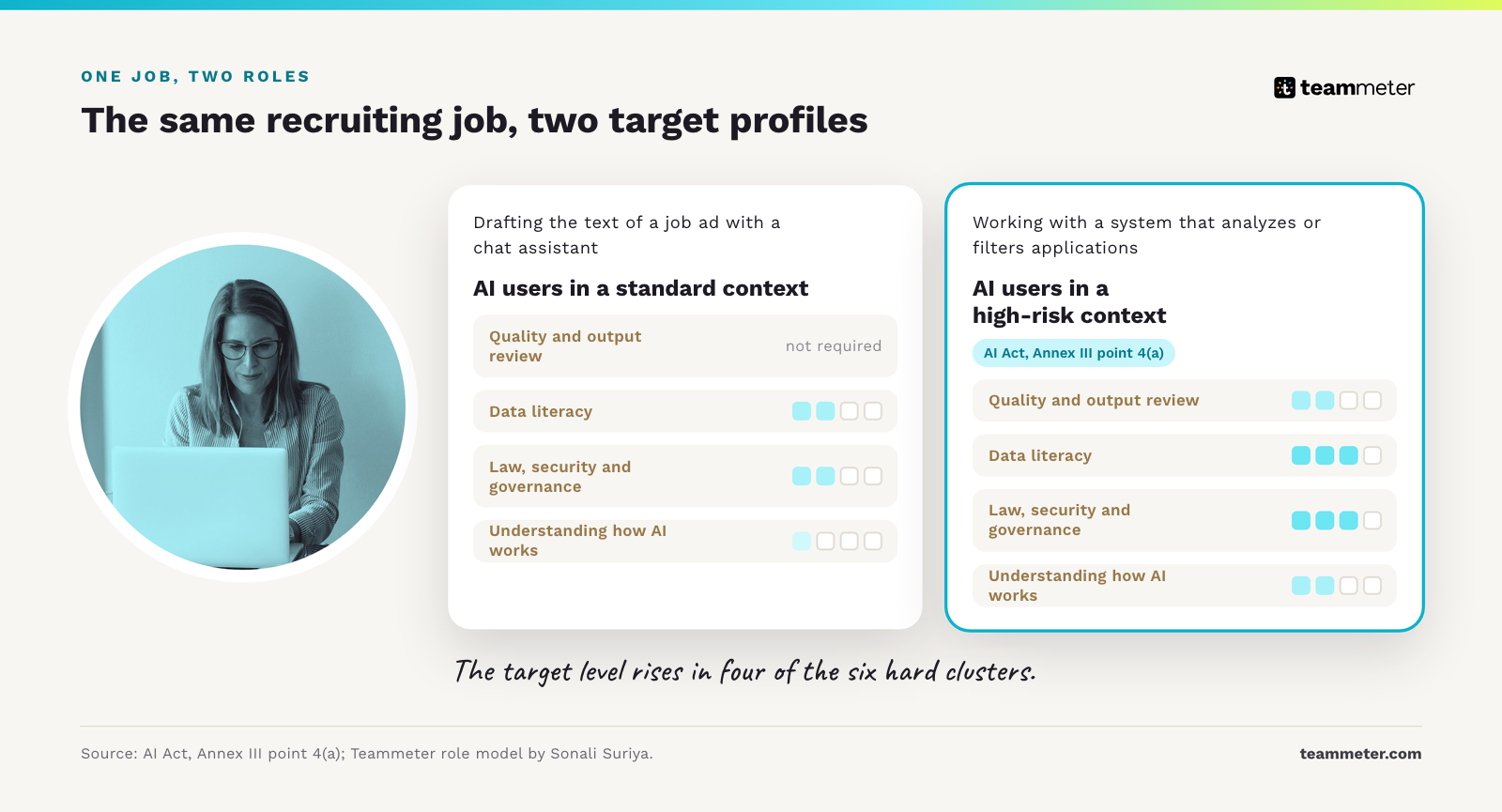
Both role profiles then apply to this person. In the high-risk context, the target level rises in four of the six hard clusters. In quality and output review, for example, level 2 is added, which the standard context does not require at all: reading the quality metrics and test results of the system in use and understanding what they say. Since the Digital Omnibus, the requirements of Chapter III, Sections 1 to 3 apply to high-risk AI systems under Annex III from 2 December 2027.
From the gap to a training plan
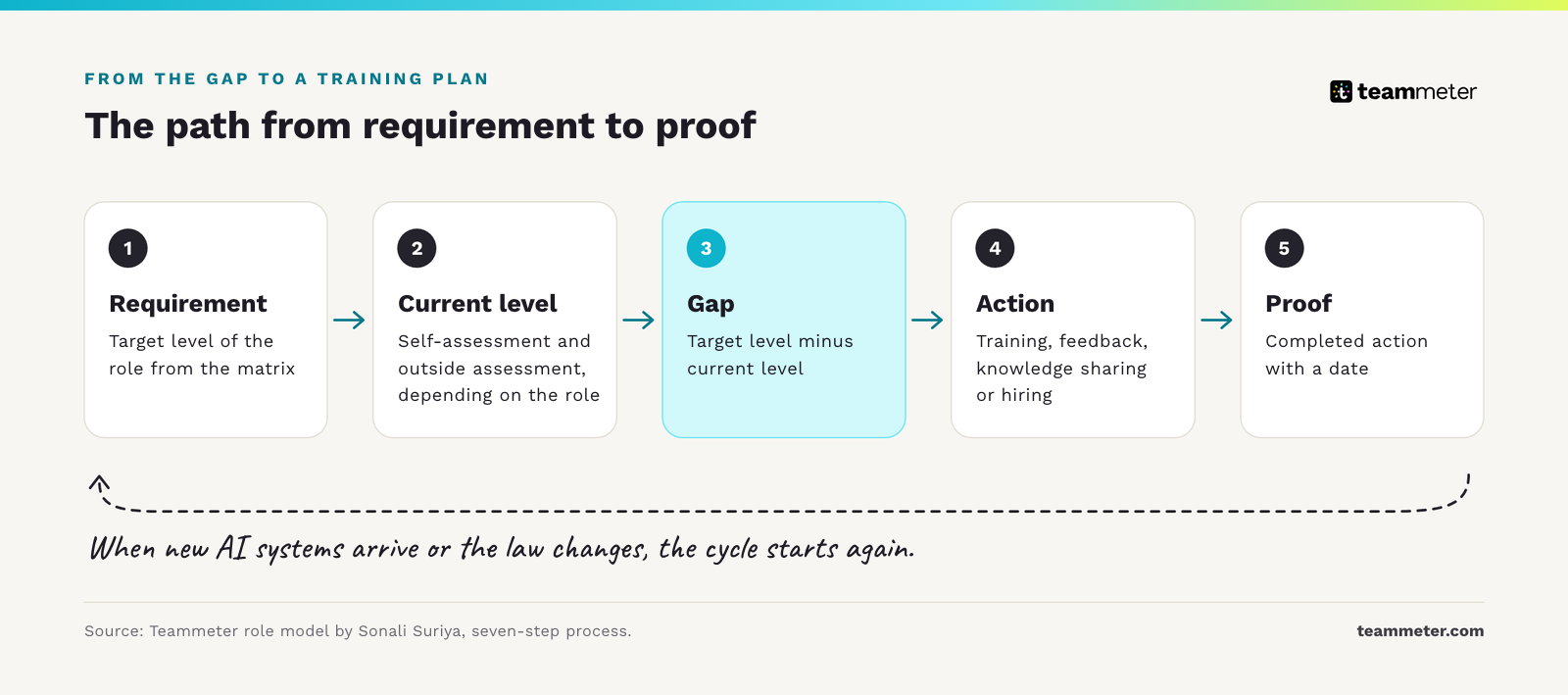
The gap is the target level of the role minus the current level. You calculate it for every person and roll it up for teams and the whole organization. Sonali writes in her model that a score of 3 is “neither good nor bad in itself”: it only becomes one or the other when compared with the target level of the role in question.
Assessing the current level
How you assess the current level depends on the role. For multipliers, the manager confirms it, because this role guides others.
| AI role | Assessment method |
|---|---|
| AI users in a standard context | Self-assessment |
| AI users in a high-risk context | Self-assessment and case work |
| AI multipliers | Self-assessment and confirmation by the manager |
| AI process designers | Self-assessment and a conversation with the manager |
| AI owners | Self-assessment and calibration among the leadership team |
For soft skills that others can observe, an outside view is added; for cognitive ones, Sonali’s model makes it mandatory. For leadership skills, she also advises against averaging self-assessment and outside assessment, because the distance between the two is often the real finding.
Matching actions to the gap
The gap tells you what a person or a team needs. There are more ways to close it than training:
- Training: for hard AI skills, which people learn through knowledge and practice. A second assessment right after the training is worth it.
- Practice with feedback: for soft AI skills, which grow in development conversations, coaching, everyday feedback and retrospectives.
- Internal knowledge sharing: for teams where scores are far apart. For such areas, Brandstetter recommends mentoring formats in which more experienced colleagues share what they know. You do not need to book a course for a skill the team already has.
- Hiring: for cases where the organization lacks people with the AI skills it needs. Christophe Vantighem from Teammeter distinguishes three routes for this: develop, move internally or hire. How to check this in workforce planning is covered in the article on AI skills.
Recording proof
You record completed actions and update the level. According to the European Commission, a certificate is not required. Its questions and answers say:
“There is no need for a certificate. Organisations can keep an internal record of trainings and/or other guiding initiatives.”
Which software works for an AI skills matrix?
The Excel template is enough for a first round. When you choose software, these requirements, taken from the steps above, will help:
- Roles: a target level per skill, and several roles for one person
- Scale: described levels, with behavioral anchors for soft skills
- Assessment: self-assessment and outside assessment, depending on the role
- Gap: for every person, every team and the whole organization
- Proof: completed actions with a date, and a reminder for the next assessment
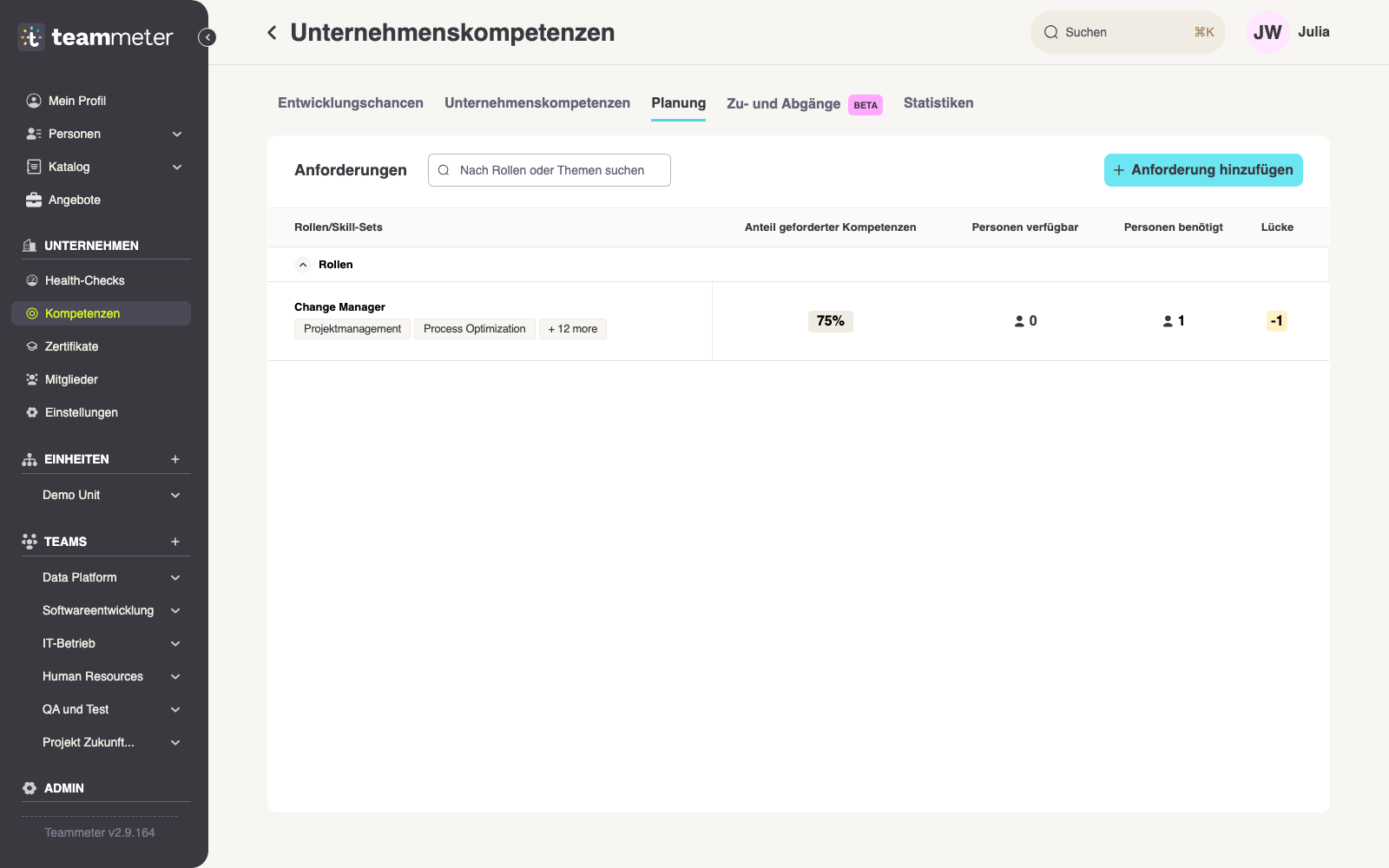
In Teammeter, you create roles with their required skills in the “Skill catalog”, and for each role the “Planning” view shows how many people are available and how many are missing. The “Training matrix” is where you record completed trainings.
Let’s spend 30 minutes looking at the AI skills in your company together.
A short detour: what the role model builds on
The role model was built by Sonali Suriya. She studied business psychology in Hamm-Lippstadt and Bielefeld and leads sales and customer success at Teammeter. She brought it together from four independent sources:
- A peer-reviewed study: in 2026, Karl Brandstetter presented the AICompAss instrument in the European Journal of Open, Distance and E-Learning. The pilot, with eight employees of an Austrian university administration, is small. One finding still matters for role planning: how often someone uses AI says nothing about their skill on its own.
- A European framework: the appliedAI Institute for Europe has published the AI Skills Framework, free to use under the CC BY-SA 4.0 license.
- A UK government report: the rapid evidence review “AI Skills for Life and Work” of 28 January 2026 describes a skills framework that also splits employees by role, into AI Workers, AI Professionals and AI Leaders.
- Recruiting practice: on top of that comes Canditech’s glossary “Artificial Intelligence Skills”, as market practice from candidate selection.
Frequently asked questions
How do you create an AI skills matrix?
Start with a role model like the one in this article and align the roles and target levels with your business units. Then assign employees to the roles; one person can hold several roles. Next, assess the current level and derive actions from the gap. Finally, record the proof and set the date for the next assessment.
What do I do with employees who are already much further ahead?
For skill areas with a wide spread, Brandstetter suggests mentoring formats in which people with higher skills share their experience. In our model, this is the job of the AI multipliers, who spread skills across the organization.
Can the AI skills matrix feed into performance reviews?
For soft skills, Sonali’s model calls for a clear separation from performance evaluation. She describes the risk like this: as soon as people suspect that the scores feed into promotion or pay, data quality is gone. For hard skills, the fear of being judged is lower, because employees see them as a qualification.
Does the works council have to be involved?
In Germany, under Section 87(1) no. 6 of the Works Constitution Act (BetrVG), the works council has a right of co-determination in the “introduction and use of technical devices designed to monitor the behaviour or performance of the employees”. Whether software for the AI skills matrix falls under this is something to clarify with your works council. For soft AI skills, Sonali’s model adds that they are close to personality assessment and become subject to co-determination as soon as analyses are produced for whole departments.
How often do you need to update the matrix?
In Sonali’s view, the catalog of hard AI skills goes out of date within twelve to twenty-four months, so it needs a fixed review date. The soft clusters stay stable for years; only their examples and behavioral anchors need upkeep. You adjust the target levels when new AI systems arrive or the legal situation changes.
What is the difference between an AI skills matrix and a training matrix?
The AI skills matrix sets out what a role should be able to do. The training matrix records who has completed which training and when it is due again.
Sources
- European Commission: AI Literacy, Questions & Answers, as of 27.07.2026. https://digital-strategy.ec.europa.eu/en/faqs/ai-literacy-questions-answers
- Regulation (EU) 2024/1689 (AI Act), Article 6(2) and (3), Article 14(4), Article 26(2), Annex III point 4(a). https://eur-lex.europa.eu/legal-content/EN/TXT/HTML/?uri=OJ:L_202401689
- Regulation (EU) 2026/1744 (Digital Omnibus), no. 40. https://eur-lex.europa.eu/eli/reg/2026/1744/oj/eng
- Teammeter role model by Sonali Suriya (2026), brought together from the four sources below.
- Kienbaum and BPM: Künstliche Intelligenz in HR 2026, Zwischen Aufbruch und Reifeprüfung, July 2026, p. 16.
- Brandstetter, K. (2026): From Competency Models to Targeted Interventions: Fostering AI Competence as a Future Skill with AICompAss in Heterogeneous Teams. European Journal of Open, Distance and E-Learning, 28(1). https://doi.org/10.65043/eurodl.178
- appliedAI Institute for Europe: AI Skills Framework. https://github.com/aai-institute/ai-skills-framework
- Procter, R. (2026): AI Skills for Life and Work: Rapid Evidence Review. DSIT and DCMS, 28.01.2026. https://www.gov.uk/government/publications/ai-skills-for-life-and-work-rapid-evidence-review
- Canditech: Artificial Intelligence Skills (glossary, undated).
- Works Constitution Act (Betriebsverfassungsgesetz), Section 87(1) no. 6. https://www.gesetze-im-internet.de/betrvg/__87.html
