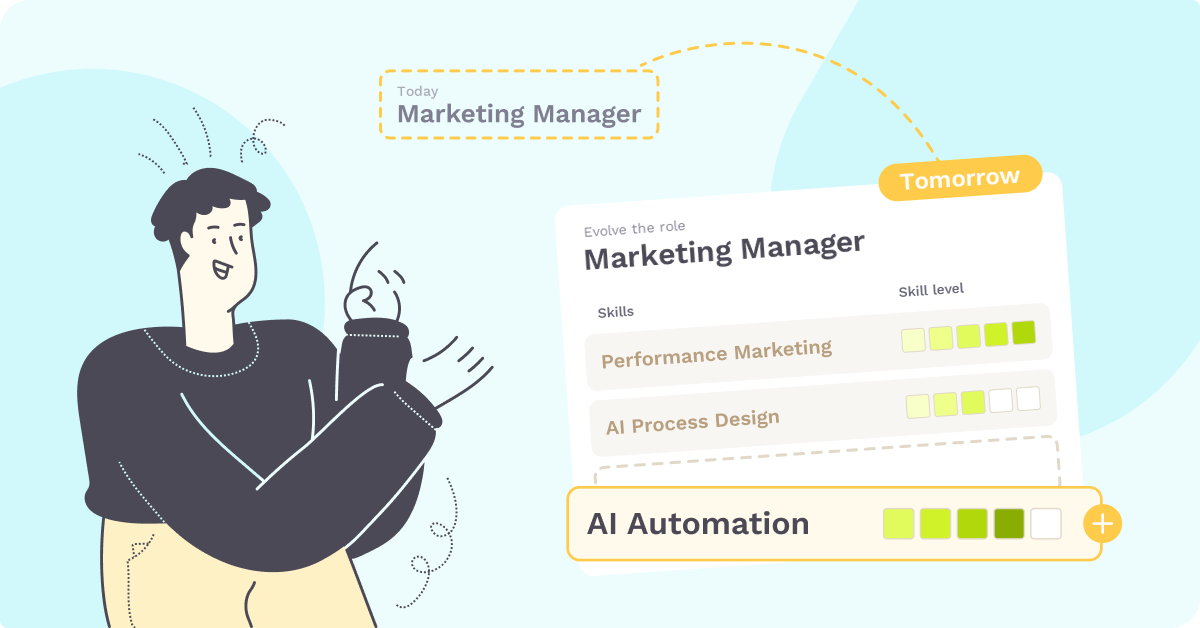
AI skills are high on the transformation agenda of many companies because they help decide whether a company stays competitive and future-proof. Since the EU AI Act, this has also become a legal obligation: companies that use AI must support the AI literacy of their staff.
AI affects not only many processes, skills and the tech stack, it also changes how almost every department looks at performance and productivity. A tension often shows up here. On one side is the pressure for productivity: companies that roll out artificial intelligence particularly effectively are often more competitive. On the other side, speed does not always mean effectiveness. As a Kienbaum study shows, tools, tokens or individual use cases matter less for successful transformation than, among other things, “a systematic build-up of AI and digital skills”.
That is exactly why roles, skills and processes need to be orchestrated more actively than ever before people and machines can work together productively.
This article covers how to describe AI skills, assess where your employees stand today, keep that up to date and find the gap per team and role.
What Are AI Skills?
AI skills are all the abilities and knowledge needed to use artificial intelligence effectively, safely and in compliance in day-to-day work. For HR, Kienbaum and BPM count among them:
- in-depth knowledge of generative AI, for example its application and prompting
- people analytics and data analysis
- digital HR systems
- a reflective approach to ethical and regulatory questions
In practice, the last point also means checking AI results critically and recognizing bias. For high-risk systems such as the pre-selection of applications, the AI Act explicitly names automation bias, the tendency to over-rely on the output of a system (Article 14).
This is not to be confused with the term AI literacy. It comes from the AI Act and describes the basic literacy that companies are to support in their staff. What exactly it means is explained in the AI Act section below.
Why AI Skills Matter
In a Bitkom survey of 603 companies in Germany with 20 or more employees, 66 percent rate the AI skills of their employees as low and only 28 percent as high. 70 percent train their employees in using AI: 11 percent train all of them, 22 percent a large share and 37 percent selected employees.
HR itself sees a considerable skill gap in its own function. In the Kienbaum and BPM study, the average share of HR staff with sound AI and digital skills is around 30 percent today, and HR departments expect around 80 percent for 2030. In the future, the study sees AI skills increasingly as a basic ability of the whole function.
Use is most advanced in recruiting and onboarding. According to the study, 35 percent of HR departments use generative AI productively there, up from 18 percent in 2024.
According to the WEF Future of Jobs Report 2025, technological skills such as AI and big data are growing fastest. At the top of the core skills, the WEF lists analytical thinking, followed by “resilience, flexibility and agility” and “leadership and social influence”. However, the WEF attributes their rise mainly to the economic situation and geoeconomics.
For HR in the AI transformation, we frame these skills more sharply:
- Active self-regulation: resilience is one part of it. Self-efficacy and the ability to keep learning belong to it as well.
- Agility: agility and flexibility overlap strongly, so one term is enough.
- Leadership and shaping change: leading can also mean administering. In the AI transformation, what counts is that leaders shape change.
- Communication and collaboration: this is more concrete than social influence.
Practical Example: How Cleveland Clinic Broke a Role Down into Tasks
Faced with talent shortages in health care, Cleveland Clinic’s workforce planning group turned to role design. It broke roles down into tasks and asked for each one whether it needed to be done at all, and whether it could be automated, performed remotely, reassigned or rescheduled. For medical assistants, the analysis led to shifting most tasks, 37 of 40, to lower credentialed or non-clinical staff and to automating or augmenting others with technology. The result was capacity equivalent to 430 full-time employees and more than 2 million dollars in cost savings. Engagement rose because staff could spend more time on patient care instead of paperwork (“2026 Global Human Capital Trends”, p. 41).
Our reading for HR: Cleveland Clinic first clarified which tasks stay with a role. Only from there does it follow which skills the role needs now. Step 2 below starts exactly there.
What AI Skills Management Means
AI skills management is the overarching process in which you systematically capture:
- who in your company needs which AI skill
- where these people stand today
- how the path from today’s level to the target level is designed
The same principles apply to AI skills as to any other skill. Depending on the task or functional area, a role comes with certain AI skills. For each of them, the level the role needs is defined. A self-assessment and an assessment by the team lead show where employees stand today. The goal is to close the gap with targeted training for each role, so that employees can make full use of AI in their daily tasks.
This pays off for both sides. For the company, AI only raises productivity once people can work with it. A European telecommunications company added an AI “expert” to customer service without changing roles or workflows and gained 5 percent in productivity. When 90 percent of the rollout budget went into new workflows and robust training, the gain was 30 percent (“2026 Global Human Capital Trends”, p. 9). Employees, in turn, are enabled to handle their tasks in the AI transformation with confidence in their own abilities.
One difference to other professional skills is the pace at which they change. According to the PwC AI Jobs Barometer 2025, the skills sought by employers are changing 66 percent faster in the occupations most exposed to AI. It is therefore not enough to know who has completed an AI training. You also need to see when, with which tool and at what level.
AI Literacy under the AI Act
What Is AI Literacy under the AI Act?
In Article 3(56), the AI Act describes AI literacy as “skills, knowledge and understanding” that allow people to make an informed deployment of AI systems and to gain awareness of the opportunities and risks of AI and the possible harm it can cause. Article 4 has applied since 2 February 2025. In the version in force since July 2026, providers and deployers of AI systems take measures “to support the development of AI literacy” of their staff and other persons dealing with the operation and use of AI systems on their behalf, taking into account their technical knowledge, experience, education and training and the context the AI systems are to be used in.
In short: AI literacy is not only a transformation topic but a legal prerequisite for using AI. A company does not have to guarantee a specific level for each individual.
How Do You Implement the AI Literacy Obligation?
There is no one-size-fits-all approach, and the AI Act does not prescribe a specific mandatory training, according to the Commission in its FAQ on AI literacy. As the minimum content of a programme, the Commission names four steps:
- Ensure a general understanding: people in the organization know what AI is and which AI is used, including its opportunities and dangers.
- Clarify your own role: the organization knows whether it develops AI systems itself or uses systems from other providers.
- Assess the risk: for each AI system, it is clear what staff need to know about it and which risks they need to be aware of.
- Tailor the measures: the measures follow the prior knowledge of the staff and the purpose the system is used for.
The European Commission gives its own example of how concrete this can get. If employees use ChatGPT for writing advertisement text or translating, they should be informed about the specific risks, for example hallucination. In many cases, simply relying on the instructions for use is not enough, according to the Commission. For high-risk systems, such as AI that analyses or filters job applications (Annex III), Article 26 also requires staff to be sufficiently trained to handle the system and ensure human oversight.
Do You Need Evidence of AI Literacy?
There is no need for a certificate, and organizations can keep an internal record of trainings and other initiatives. This is how the European Commission answers it in its questions and answers on AI literacy. There is accordingly no obligation to measure employees’ AI knowledge, and Article 4 does not require a dedicated AI officer either. This article is not legal advice.
Free e-book
AI in HR: Opportunities, Risks, 5 Best Practices
Discover how AI is reshaping talent management and what HR leaders must do now to stay ahead.
Which Software Helps with Implementation?
For the internal record, an overview of who completed which training and when is enough, for example in a training matrix. It does not show whether the skills fit the role. For that, you need a skill management software in which the requirements per role and today’s level sit side by side. The next section shows how this works step by step.
The Process: How to Build AI Skills Deliberately in Your Organization
In organizations with around 200 employees or more, this rarely starts from scratch. In our conversations with HR teams of this size, mandatory trainings regularly already had a fixed process with due dates, certificates and evidence. The following five steps build on that.
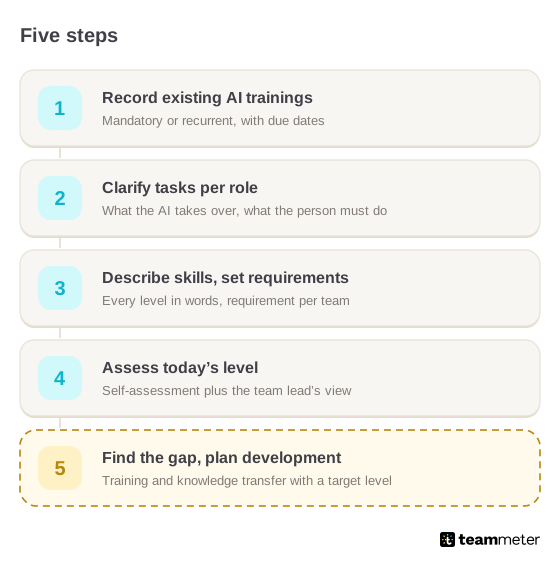
Step 1: Record Existing AI Trainings
If there are already AI trainings, such as a basic AI literacy training under Article 4, manage them in the training matrix, as mandatory or recurrent, with a due date. For certificates, you see whether they are valid, expiring soon or expired. Attendance, however, says nothing yet about what someone can do with AI in their own role. Our playbook on upskilling and reskilling distinguishes three levels: whether a training happened, whether it changed behavior and whether it changed an outcome. The training matrix shows the first level. The next steps are there for the other two.
Step 2: Clarify Tasks per Role
You find out which AI skills a role needs through its tasks. AI rarely shifts the whole role at once, but individual tasks within it, as the task analysis at Cleveland Clinic shows. So clarify with the team lead, role by role, which tasks the AI takes over and what the person then needs to be able to do.
Before you measure today’s level, it pays to look at what the job market expects from the role. The KI-Kompetenzmonitor by index analyzes German job ads by occupational group, industry and federal state. According to index, that is more than 25 million ads a year. In the second quarter of 2026, the ten most frequently named AI technologies included ChatGPT, Microsoft Copilot and prompt engineering. The monitor counts tools and terms, not skills such as checking an AI result. It shows you which tools are arriving in a role. Which skills the tasks with these tools require, you derive yourself.
Step 3: Describe Skills and Set Requirements
The tasks turn into skills in the skill catalog. Every skill needs a scale that describes in words what each level means. Without that description, everyone assesses by their own standard. The results then cannot be compared. How to build a catalog like this is explained in our article on the skill catalog, and how many levels a scale needs in our article on the skill scale.
Then the team decides how many people need a skill at which level. This decision is not HR’s alone. The team lead knows best which tasks the AI takes over and where a person has to decide. This requirement is the benchmark for the gap later on.
Step 4: Assess Today’s Level
The assessment comes from two directions. Employees assess themselves, and the team lead adds their view. Both use the same described scale. In addition, each person can set a target if they want to develop in a skill.
In the assessment, ask about the task, not the tool. For a task that AI supports, that means asking how someone checks the result the AI delivers.
Step 5: Find the Gap and Plan Development
Requirement and current level give you the gap per skill and team, and if needed for an entire unit. Sorted by the size of the gap, you see where training should start first. People who already have a skill appear in the matrix with their level. You can plan them in for knowledge transfer before you buy an external training.
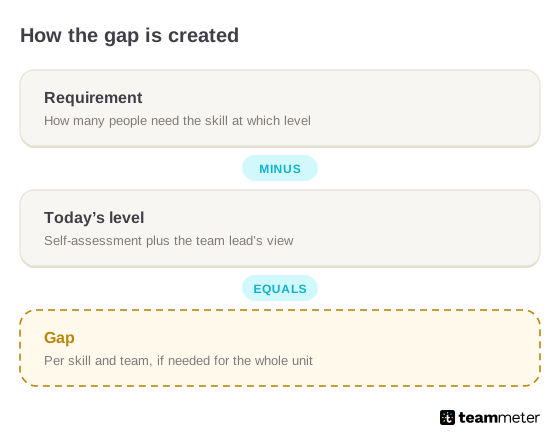
The gap turns into actions. Each one goes into the person’s development plan with a target level:
- External training: when nobody in the team can pass the skill on
- Internal team training: when several people have the same gap
- Knowledge transfer: when colleagues already have the skill at a high level
How to combine these methods is covered in our playbook on upskilling and reskilling. If almost nobody in a team is close to the requirement, that is more a question for hiring than for training. If AI removes tasks, check where the person is needed most in the company.
Repeat the assessment at fixed intervals, because the tasks keep shifting along with the tools.
Practical Example: How Save the Children Norway Rolled Out AI
Redd Barna, the Norwegian member of Save the Children, shows what a structured AI program looks like across a whole organization. For a year, AI tools were introduced without a fixed structure. Use remained uneven: only half of the registered staff actively used the approved tool, and valuable use cases were identified more slowly than expected. With Deloitte, the organization then set up a structured program:
- Roles: AI ambassadors with focus groups and support tools, plus workshops with leadership on the AI roadmap
- Skills: practical, example-driven training, workshops and success stories
- Processes: behavioral guidelines and KPIs for effective AI use, a systematic prioritization of use cases by organizational goals, KPI tracking and regular reviews
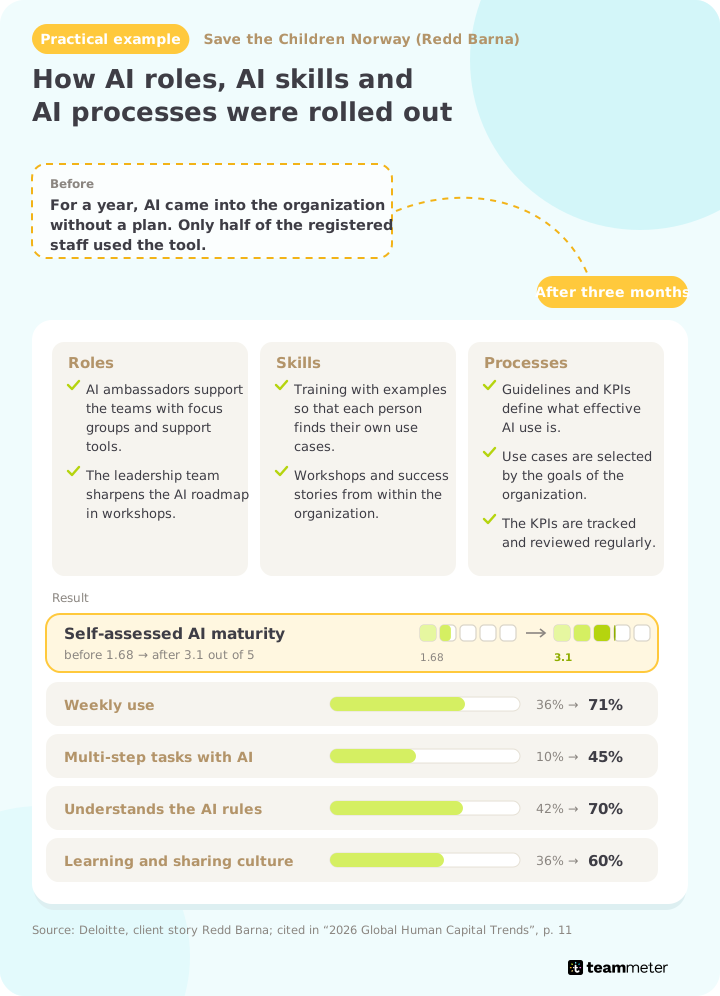
After three months, weekly use had nearly doubled, from 36 to 71 percent. Self-assessed AI maturity rose from 1.68 to 3.1 on a 5-point scale. This is how Deloitte describes it in the client story, which also appears in its “2026 Global Human Capital Trends” (p. 11).
Our reading for HR: the tool was available for a year, and half of the staff used it. Things only moved once roles, training and rules were added. AI maturity was measured as a self-assessment on a scale, just as described in step 4. Whether the assessment was done per role, the client story does not say.
FREE SESSION
Let’s exchange ideas in a 30-minute sparring
Get a fresh perspective on your topic.
In this free 30-minute sparring session, we’ll explore ideas, challenge assumptions, and identify practical next steps.

AI Skills Management with Teammeter
Teammeter is a skill management software. You create AI skills in the skill catalog, set the requirements per role and see in the skill matrix per team where the gap is. Teammeter does not test AI skills and does not deliver learning content.
Frequently Asked Questions
What AI skills are there?
AI skills fall into hard and soft skills. Four sources yield six bundles of each. The hard bundles are AI functional knowledge, use of AI tools, data literacy, quality and output review, law, security and governance, and technical development and operations. The soft bundles are critical and reflective judgment, ethical responsibility, decision-making and problem-solving, communication and collaboration, self-regulation and learning ability, and leadership and shaping change.
How do hard and soft AI skills differ?
Hard AI skills are learned through knowledge and practice, and a training measure has a clear beginning and end. Soft AI skills are behavioral. They need opportunities for application, feedback and reflection, and they have no fixed end point. Hard skills are therefore mainly about evidence, soft skills about development. Each needs its own way of measuring.
Do all employees need the same AI skills?
Not for hard skills. How deep they need to go depends on the activity, and a basic level applies to everyone. Soft AI skills concern all employees equally, regardless of their function. Needs therefore depend on the activity and not on the hierarchy.
Which roles are there in the use of AI?
Five roles can be distinguished, and one person can hold several of them. AI users in a standard context use AI as a tool in their own work, for example to draft, research or summarize. AI users in a high-risk context work with systems that affect people, for example in selection or performance appraisal, and are the human oversight there. AI multipliers carry skills into the team and are the first point of contact there. AI designers decide how AI is used in their own business process. AI owners decide on procurement, risk classification and rules.
Which scale is used to measure AI skills?
For hard AI skills, a four-level scale combined from three academic sources works well.
| Scale level | Level name | What it means |
|---|---|---|
| 1 | Knowing | knows what it is about, can join the discussion and recognizes the relevance |
| 2 | Applying it | acts independently under familiar conditions |
| 3 | Transferring | acts confidently in new, more complex situations |
| 4 | Shaping and passing on | develops further, advises and qualifies others |
For soft AI skills, the level alone is not enough. They need psychological behavioral anchors that describe which behavior is expected at a level.
Is a self-assessment enough?
For hard AI skills, yes, because practice corrects it. It can be supplemented by evidence and work samples. For soft skills, it depends on the skill. Where only the person has insight, a self-assessment with a validated short scale is enough. For skills that others can observe, an external perspective is added, and for cognitive skills it is mandatory. In a high-risk context, working through a case is also part of the assessment.
How often should AI skills be assessed?
Hard AI skills every six months, because requirements shift quickly. Re-measuring directly after a training measure is worthwhile. For soft skills, an overall profile once a year is enough, plus in-depth check-ins every quarter on two to three self-chosen focus areas. Their effect can realistically only be shown after twelve to eighteen months.
Why do AI competency models fail?
With hard AI skills, the catalog goes out of date faster than it is maintained, usually within twelve to twenty-four months. Or the measurement stops at knowledge, and no application develops in everyday work. With soft skills, the risk is arbitrariness. Without a defined target level, every current value is meaningless, no gap emerges and therefore no action follows.
Sources
- Kienbaum and BPM: Künstliche Intelligenz in HR 2026
- Bitkom: KI in der deutschen Wirtschaft, press release of 14 September 2026
- Deloitte: 2026 Global Human Capital Trends
- Deloitte: client story Redd Barna (Save the Children Norway)
- WEF: Future of Jobs Report 2025
- PwC: 2025 Global AI Jobs Barometer
- EU AI Act, Articles 4 and 14, Annex III
- European Commission: AI Literacy, Questions and Answers
- index: KI-Kompetenzmonitor
- Brandstetter, K. (2026): From Competency Models to Targeted Interventions: Fostering AI Competence as a Future Skill with AICompAss in Heterogeneous Teams. European Journal of Open, Distance and E-Learning, 28(1)
- Burkhart, C., González Avalos, P., Goll, F. (2026): Bringing AI skills into practice: The AI Skills Framework for the professional use of AI. appliedAI Institute for Europe
- Procter, R. (2026): AI Skills for Life and Work: Rapid Evidence Review. Department for Science, Innovation and Technology, GOV.UK
- Canditech: Artificial Intelligence Skills (glossary)
